Hydraulic Scissor Lift:
Complete Guide for 2026
Everything facility managers, procurement officers, and engineers need to know before purchasing or specifying a hydraulic scissor lift — from working principles to cost benchmarks, safety standards and GCC compliance.
Quick summary: A hydraulic scissor lift uses pressurized fluid to extend linked scissor arms and raise a platform. They are the go-to solution for loading docks, warehouses, factories, car workshops, and mezzanines — offering capacities from 500 kg to 30+ tons and platform heights from 1 m to 12 m.
1. What Is a Hydraulic Scissor Lift?
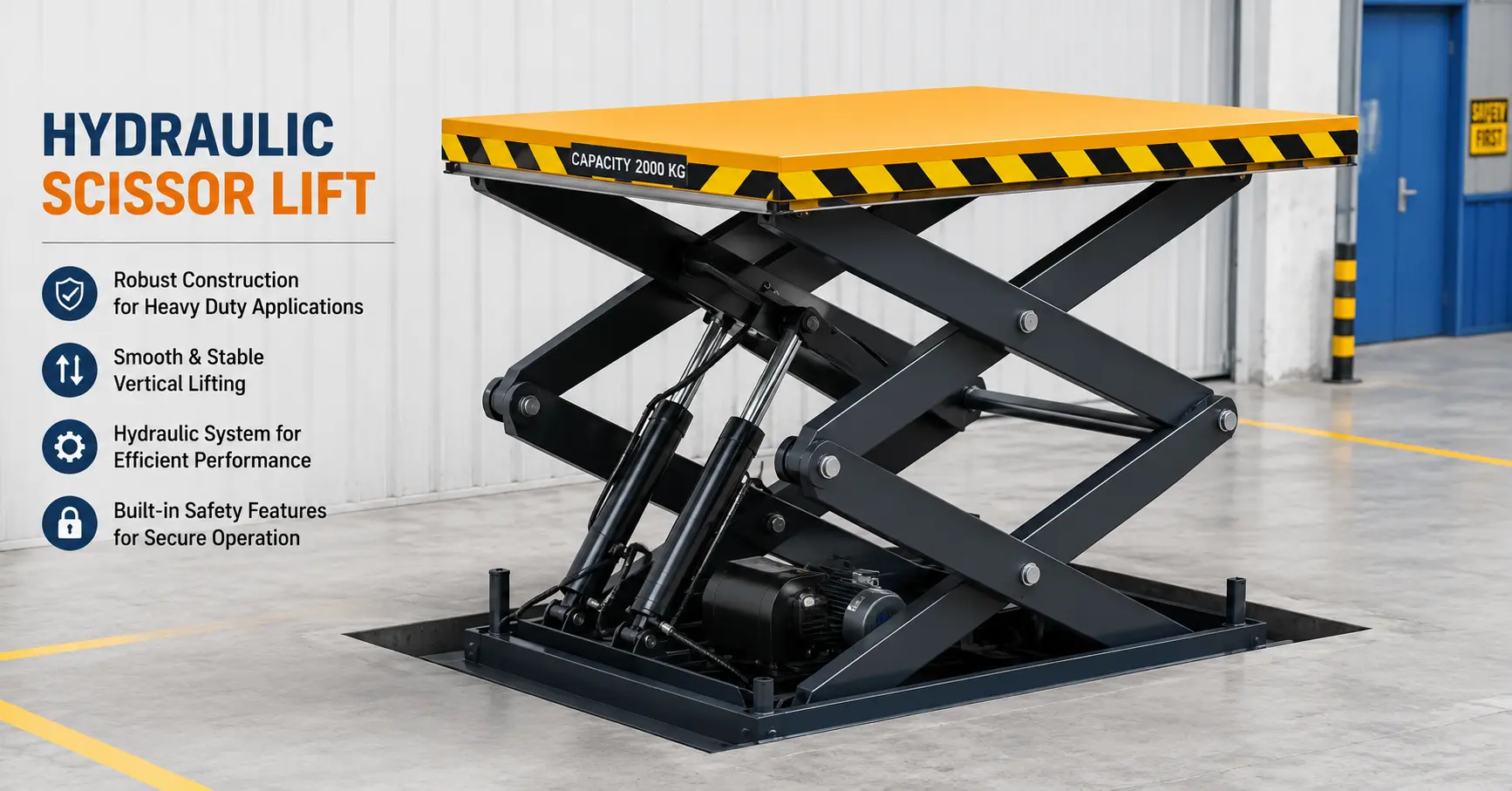
A hydraulic scissor lift is a type of work platform or goods-moving machine that uses hydraulic cylinders to extend a set of crossed, folding supports — shaped like the blades of scissors — to raise a platform vertically. Unlike pneumatic or mechanical lifts, the hydraulic variant uses pressurized oil to generate the massive force required to elevate heavy loads smoothly and reliably.
These lifts are one of the most widely deployed pieces of material-handling equipment globally, found in manufacturing plants, warehouses, loading bays, car service stations, airports, and construction sites. Their popularity stems from a combination of mechanical simplicity, high load capacity, low maintenance requirements, and competitive cost.
In the GCC region — particularly the UAE, Saudi Arabia, and Qatar — hydraulic scissor lifts are increasingly in demand as infrastructure investments and warehouse construction accelerate. MIE Industry has been supplying and installing lift solutions across these markets for over two decades.
2. How Does a Hydraulic Scissor Lift Work?
Understanding the working mechanism helps you select the right configuration and troubleshoot problems effectively.
- Hydraulic Pump Activation: An electric motor (or hand pump on manual units) pressurizes hydraulic oil inside a reservoir and pushes it into the cylinder via a control valve.
- Cylinder Extension: Pressurized oil enters the hydraulic cylinder(s), extending the piston rod outward.
- Scissor Arm Expansion: The piston rod is connected to the lower scissor arm. As it extends, the cross-linked arms unfold, converting horizontal force into vertical lift.
- Platform Rises: The top platform, welded or bolted to the upper scissor pivot, rises vertically along with the load.
- Lowering: The control valve releases oil back to the reservoir under gravity or a controlled bleed valve, lowering the platform at a safe, controlled rate.
Key Components
- Hydraulic cylinder(s) – single or double-acting, depending on load
- Pump & motor unit – powers fluid flow; rated in bar/psi
- Control valve – directs and regulates oil flow
- Scissor arms – typically fabricated from high-tensile structural steel
- Platform deck – checker plate, smooth steel, or custom surface
- Safety legs / safety valves – prevent uncontrolled descent
- Limit switches – electronic stops at max/min travel
3. Six Main Types of Hydraulic Scissor Lifts
Selecting the right type depends on your load, height requirement, mobility needs, and installation environment. Here are the six principal categories:
Installed flush with the floor in a pit, creating a level loading surface. Ideal for loading docks and production lines where goods are transferred at floor level.
Loading Dock Factory Flush FloorMounted on wheels or casters, powered by battery or hand pump. Widely used in workshops, warehouses, and maintenance tasks where flexibility is needed.
Workshop Maintenance Battery-PoweredBridging the height gap between truck beds and warehouse floors. Available as vehicle-mounted, edge-of-dock, or standalone hydraulic dock levelers.
Logistics Warehouse Truck LoadingSpecifically engineered to raise vehicles for undercarriage inspection and servicing. Available in two-post, four-post, and scissor configurations.
Service Station Parking GarageVertical transport of goods between floor levels without needing a full freight elevator shaft. Enclosed platform with safety gates for industrial mezzanines.
Multi-Floor Goods No Shaft RequiredCombines electric control systems with hydraulic power for smooth, programmable lifting. Used in high-precision manufacturing and cleanroom environments.
Precision Programmable Cleanroom4. Technical Specifications Explained
When comparing or specifying a hydraulic scissor lift, these are the critical technical parameters to evaluate:
| Load Capacity | 500 kg – 30,000 kg (varies by model) |
| Platform Height (max) | 1,000 mm – 12,000 mm |
| Platform Size | 800×800 mm to 4,000×6,000 mm (custom) |
| Lowered Height | 300 mm – 700 mm (depends on scissor stacks) |
| Hydraulic System Pressure | 150 – 350 bar |
| Motor Power | 0.75 kW – 15 kW (single or three phase) |
| Lifting Speed | 3 – 12 m/min |
| Power Supply | 220V/380V/415V, 50/60 Hz |
| Control Options | Push button, remote, PLC, wireless |
| Protection Class | IP54 standard, IP65 for washdown environments |
| Frame Material | Q345 high-tensile structural steel |
| Surface Treatment | Shot blast + epoxy primer + polyurethane topcoat |
5. Top Industrial Applications
Hydraulic scissor lifts serve a remarkably wide range of industries. Below are the most common and growing application areas across the UAE and GCC markets.
Warehousing & Logistics
Loading dock lifts reduce manual handling injuries and speed up truck turnaround times significantly. A properly specified dock leveler or pit-mounted scissor table eliminates the height mismatch between truck beds and warehouse floors, allowing forklifts and pallet trucks to transition seamlessly. See our guide on warehouse layout planning in Saudi Arabia for integration strategies.
Manufacturing & Production
Assembly line ergonomics depend on positioning workers at the correct working height. Height-adjustable scissor tables reduce musculoskeletal injuries and increase productivity by bringing components to a comfortable level rather than forcing workers to bend or stretch.
Automotive Service
Car scissor lifts allow technicians to access the undercarriage without a pit, are space-efficient, and can be retracted flat when not in use — a significant advantage in compact workshops. Learn more about our hydraulic car lift solutions.
Multi-Level Goods Transfer
Mezzanine and freight scissor lifts move goods between floors without the expense of a full shaft elevator. These are ideal for retail stockrooms, factories with multiple levels, and warehouses with elevated storage areas. Our freight elevator range covers both scissor and enclosed lift options.
Construction & Maintenance
Mobile scissor platforms provide access for electrical, HVAC, and façade maintenance work at heights up to 10–14 m. These are often rented for project-based work rather than purchased outright.
Aircraft & Airports
Specialist low-profile scissor lifts with certified load ratings are used for aircraft maintenance, baggage handling, and catering vehicle loading in airports across the region.
🌍 Growing Demand in UAE & Saudi Arabia
- Saudi Vision 2030 industrial & logistics park developments are creating massive demand for dock and mezzanine lift systems.
- Dubai’s thriving e-commerce sector has driven warehouse automation investment, with hydraulic goods lifts at the core.
- New manufacturing free zones in Abu Dhabi and Ras Al Khaimah require GCC-compliant lift installations from certified providers.
6. Hydraulic Scissor Lift Price Guide (2026)
Pricing varies significantly by capacity, height, configuration, and customization level. The table below provides realistic market reference ranges for the UAE and GCC region, inclusive of basic installation but excluding civil works.
| Type | Capacity | Max Height | Est. Price (USD) |
|---|---|---|---|
| Stationary Table Lift | 500 kg – 1 ton | 1.5 m | $2,500 – $6,000 |
| Stationary Table Lift | 2 – 5 ton | 2 m | $7,000 – $18,000 |
| Pit-Mounted Dock Leveler | 5 – 10 ton | 600 mm travel | $9,000 – $22,000 |
| Mezzanine Goods Lift | 1 – 3 ton | 5 m | $12,000 – $35,000 |
| Mobile / Portable | 300 – 1,000 kg | 4 m | $3,500 – $10,000 |
| Automotive Scissor Lift | 3 – 5 ton | 1.8 m | $4,000 – $14,000 |
| Heavy Industrial | 10 – 30 ton | 3 m | $30,000 – $90,000+ |
Note: These are indicative ranges. Custom platform sizes, stainless steel finish, explosion-proof motors, remote PLC controls, or ATEX certification add to the base price. Contact MIE Industry for a project-specific quotation.
Factors That Affect the Final Price
- Platform dimensions and custom cutouts
- Number of scissor stacks (single, double, or triple)
- Travel height required
- Load capacity and dynamic load factor
- Control system complexity (manual, semi-auto, PLC)
- Paint specification and surface treatment
- Civil works (pit excavation, reinforcement)
- Safety extras: safety legs, anti-drop valves, velocity fuses
- Compliance certification (CE, SASO, TÜV, Dubai Municipality)
7. Safety Standards & Compliance
Safety is non-negotiable when specifying lifting equipment. In the GCC region, compliance typically references a combination of European, ISO, and regional standards.
| EN 1570 | Safety requirements for lifting tables (EU/CE basis) |
| ISO 9386 | Platform lifts for persons with impaired mobility |
| ASME B20.1 | Safety standard for conveyors and related equipment |
| SASO / SABER | Saudi Arabian Standards Organisation product certification |
| Dubai Municipality | NOC and inspection approval for fixed installations in Dubai |
| PSSR 2000 (UK) | Pressure systems safety regulations for hydraulic circuits |
| CE Marking | Required for equipment supplied to EU; widely recognised in GCC |
Mandatory Safety Features
- Hydraulic anti-drop / velocity fuse valves on all cylinders
- Mechanical safety legs that engage automatically at working height
- Overload protection (pressure relief valve + load sensor)
- Emergency stop button at platform and ground level
- Perimeter toe guards and safety skirts on platform edges
- Limit switches at maximum travel to cut motor power
- Audible / visual warning alarm when platform is in motion
- Lockable isolator switch to prevent unauthorised use
- Rated load plate affixed permanently to platform
- Annual third-party inspection and load test certification
8. Buying Guide: What to Look For
Before committing to a purchase, run through this checklist to ensure you specify the right machine and avoid expensive surprises post-installation.
Step 1 – Define Your Load
Calculate the maximum load weight (product + pallet + forklift or trolley weight if driven on). Apply a safety factor of 1.25 minimum when specifying capacity. A 2-ton actual load should be specified as 2.5-ton capacity.
Step 2 – Determine Height Requirements
Measure the required platform height at its highest point. Add clearance for the platform’s lowered height when determining whether a pit installation is required. For flush-floor dock applications, always choose pit-mounted.
Step 3 – Assess the Environment
Outdoor lifts require stainless steel fasteners, IP65 electrical enclosures, and appropriate paint systems. Chemically aggressive environments (food processing, battery rooms) need special coatings and seals. Hazardous areas (fuel storage, paint shops) require ATEX-rated motors and controls.
Step 4 – Choose the Right Supplier
- Verify supplier certifications and local installation references
- Confirm availability of spare parts and local service engineers
- Check whether the quote includes commissioning, load testing, and handover documentation
- Ask for an IOM (Installation, Operation & Maintenance) manual in English and Arabic
- Ensure a service agreement is available post-warranty
💡 Pro Tip: Total Cost of Ownership
- The cheapest lift is rarely the most economical over a 10–15 year service life.
- Factor in seal replacement (every 3–5 years), hydraulic oil change (annually), motor overhaul, and civil repair costs.
- A quality lift with local support typically costs 20–30% more upfront but delivers 60%+ lower lifetime maintenance cost.
9. Maintenance Tips for Long Life
Hydraulic scissor lifts are mechanically simple but require consistent preventive maintenance to stay safe and productive.
Daily Checks
- Inspect platform surface and deck condition
- Check for visible hydraulic oil leaks around cylinder seals and hose connections
- Test emergency stop button function
- Verify safety legs engage correctly at working height
Monthly Checks
- Check hydraulic oil level and top up with the correct ISO grade if required
- Grease scissor arm pivot pins and guide rollers
- Inspect all structural welds visually for cracks or corrosion
- Check electrical connections and control panel for moisture ingress
Annual Service (Professional)
- Full hydraulic oil change and filter replacement
- Cylinder seal inspection and replacement if weeping
- Load test at 125% of rated capacity by a certified inspector
- Structural NDT (non-destructive testing) of critical welds if required by local regulation
- Safety device function test and calibration
10. Frequently Asked Questions
11. Useful Resources from MIE Industry
Explore our expert guides and product pages to go deeper on the topics most relevant to your project:
Scissor Lift Product Range
Full catalogue of scissor lift models, capacities, and configurations.
Freight Elevator Solutions
Enclosed goods lifts for multi-floor industrial facilities.
Hydraulic Car Lift
Automotive service lifts for workshops, garages & parking systems.
Elevator Cargo System
Integrated cargo elevator systems for high-throughput operations.
Industrial Lift Manufacturer — UAE
Why MIE Industry is the trusted lift partner for UAE industry.
Warehouse Layout Planning — KSA
Strategic guide to integrating lifts in Saudi warehouse designs.
Cargo Elevator: Complete Guide
Types, costs, safety specs — everything for cargo elevator buyers.
Engine Lift Hydraulics (2026)
Complete guide to hydraulic hoists and engine lifts.
Get Expert Advice &
A Detailed Quotation
Our engineers have designed and installed hydraulic scissor lifts across the UAE, Saudi Arabia, and the wider GCC for over 20 years. Share your requirements and we’ll build the right solution for your budget and timeline.