
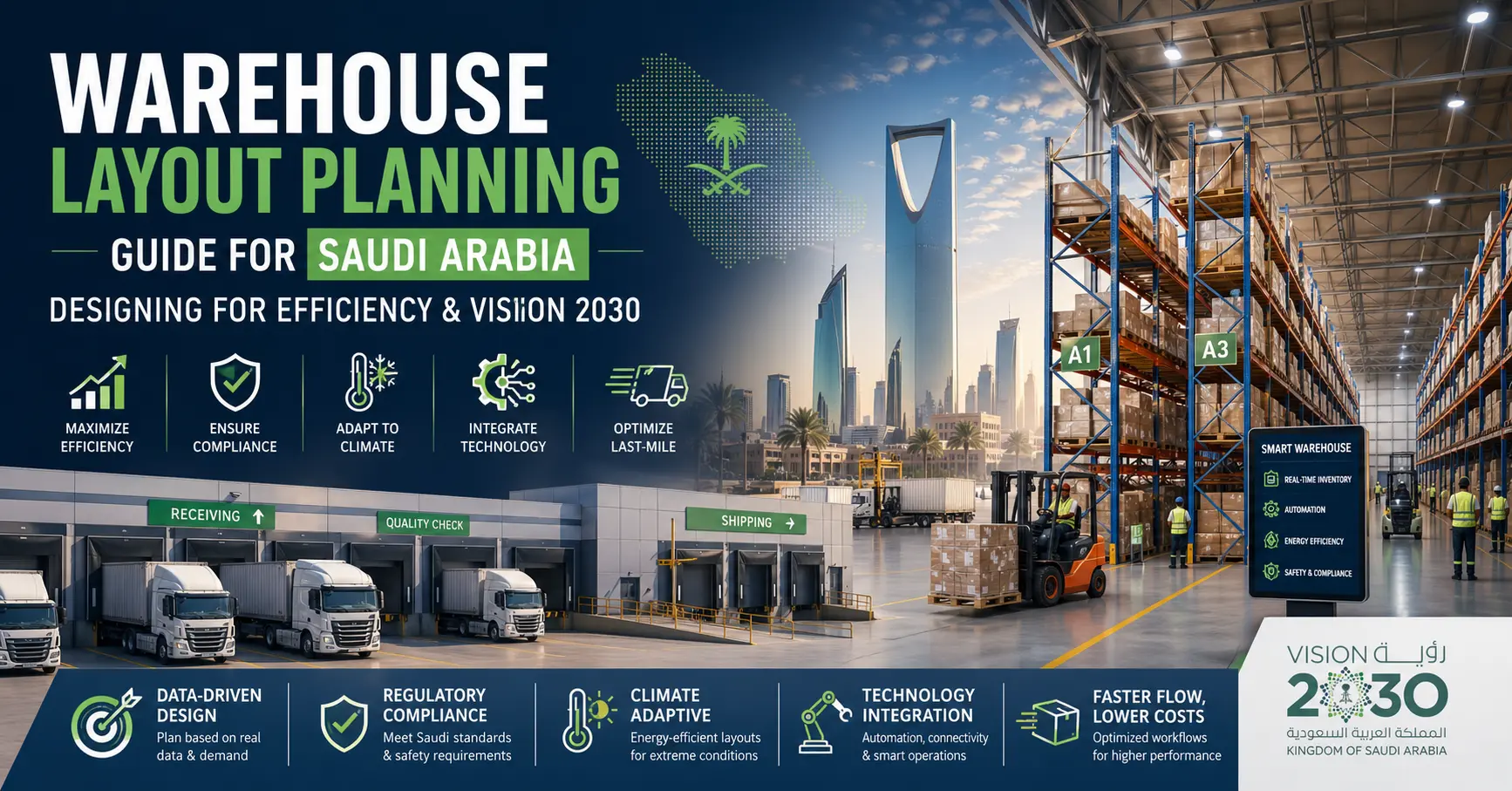
Warehouse Layout Planning Guide for Saudi Arabia: Designing for Efficiency & Vision 2030
Why Warehouse Layout Matters in Saudi Arabia
Saudi Arabia is rapidly transforming into a global logistics hub under Vision 2030. With a target of handling over 450 million tons of cargo annually, warehouse infrastructure is evolving at an unprecedented scale.
Major logistics corridors across Riyadh, Jeddah, and Dammam are witnessing increased demand for efficient, compliant, and scalable warehouse layouts.
However, designing a warehouse in Saudi Arabia is not simply about copying Western standards. It requires:
- Adaptation to extreme climate conditions
- Compliance with local regulations
- Alignment with regional supply chain patterns
A well-designed warehouse layout directly impacts:
- Throughput speed
- Labor productivity
- Safety compliance
- Long-term operational costs
Understanding the Saudi Logistics Landscape
Before designing a layout, it is critical to understand the macro trends shaping the Saudi logistics ecosystem.
Strategic Position as a Global Trade Hub
Saudi Arabia serves as a bridge between Asia, Europe, and Africa. Over 60% of imports arrive via sea routes, requiring warehouses to handle:
- Container destuffing
- High-volume inbound staging
- Cross-border distribution
Vision 2030 and Mega Projects
Large-scale developments such as NEOM, The Red Sea Project, and Qiddiya demand:
- Just-in-time delivery systems
- Multi-modal logistics integration
- Cross-docking capabilities
Workforce Transformation (Saudization)
With increasing localization policies:
- Warehouses must reduce dependency on manual labor
- Layouts should support semi-automation
- Ergonomics becomes a priority
The 5-Step Framework for an Optimized Warehouse Layout
This framework is designed for high efficiency, compliance, and scalability in Saudi conditions.
Step 1: Data-Driven Slotting and Inventory Analysis
A successful warehouse layout begins with data, not assumptions.
ABC Velocity Analysis
- Top 15–20% of SKUs generate up to 80% of movement
- Place fast-moving items near dispatch zones
- Store them at waist-to-shoulder height for easy access
Seasonal Demand Planning
Saudi warehouses experience demand spikes during:
- Ramadan
- Hajj season
Your layout should include:
- Flexible staging zones
- Expandable picking areas
- Temporary storage buffers
Step 2: Zoning for Regulatory Compliance
Saudi Arabia enforces strict storage regulations, especially for safety-sensitive materials.
Chemical and Hazardous Goods
- Must be stored in fire-rated rooms
- Require spill containment systems
- Should be isolated from other inventory
Pharmaceutical Storage
- Requires controlled temperature (15–25°C)
- Needs humidity monitoring systems
- High-security zones for restricted items
Food Storage Requirements
- Use non-porous surfaces
- Maintain hygiene separation
- Avoid cross-contamination between raw and finished goods
Compliance is not optional failure can result in shutdowns or penalties.
Step 3: Rack Configuration Optimization
Choosing the right racking system is critical for both space utilization and operational efficiency.
Selective Pallet Racking
- Most flexible system
- Suitable for mixed SKU warehouses
- Easy access to all pallets
Drive-In / Drive-Through Racking
- Ideal for high-volume, low-SKU products
- Maximizes storage density
- Requires careful heat-resistant design
Aisle Width Planning
Typical aisle width depends on equipment used:
- Standard forklifts: 3.2–3.5 meters
- Narrow aisle systems: 1.5–2 meters
Proper aisle planning ensures:
- Smooth equipment movement
- Reduced collision risks
- Improved operational speed
Step 4: Climate-Controlled Layout Design
Saudi Arabia’s extreme climate makes temperature management a key design factor.
Ventilated Spine Layout
Instead of cooling the entire warehouse:
- Create a central cooled aisle (24–26°C)
- Keep side aisles at ambient temperature
This reduces energy consumption significantly.
Dock Area Design
- Use dock shelters to prevent heat entry
- Install rapid shutter doors
- Position temperature-sensitive docks strategically
Proper climate control ensures:
- Product quality
- Worker comfort
- Lower energy costs
Step 5: E-Commerce and Last-Mile Optimization
Modern warehouses must support fast delivery systems.
Multi-Level Picking Systems
- Mezzanine floors for small-item picking
- Flow racks for continuous movement
- Conveyor integration for speed
Micro-Fulfillment Zones
- Dedicated areas for quick order dispatch
- Direct access for delivery partners
- Optimized for last-mile logistics
Sample Warehouse Layout (20,000 sqm Facility)
A typical high-performance warehouse layout includes:
| Zone | Location | Key Features |
| Receiving | North side | Dock leveling and inspection area |
| Bulk Storage | Central | High racking systems |
| Hazardous Storage | Isolated corner | Safety-compliant design |
| Picking Area | Near dispatch | Fast-moving inventory access |
| Value-Added Services | Mezzanine | Packaging and labeling |
| Shipping | Opposite receiving | Staging lanes for dispatch |
This structured zoning improves workflow and reduces bottlenecks.
Technology Integration in Modern Warehouses
A modern warehouse is not just physical it is digital.
Connectivity Infrastructure
- High-speed Wi-Fi or 5G networks
- Real-time inventory tracking
Automation Systems
- Conveyor belts
- Autonomous mobile robots (AMRs)
- Pick-to-light systems
Energy and Charging Zones
- Dedicated charging areas for electric equipment
- Proper ventilation and safety systems
Technology integration improves:
- Accuracy
- Speed
- Scalability
Fire Safety and Compliance Infrastructure
Warehouse layouts must include:
- Fire sprinkler systems
- Emergency access lanes
- Fire-resistant construction materials
Saudi Civil Defense mandates:
- Clear evacuation routes
- Adequate fire suppression systems
Safety infrastructure should be integrated during planning, not added later.
Common Mistakes to Avoid
Ignoring Worker Facilities
- Lack of rest areas reduces productivity
- Facilities must be accessible within short distances
Poor Floor Quality
- Uneven floors affect equipment stability
- Use high-quality flat flooring systems
Insufficient Staging Space
- Too many dock doors with limited staging causes congestion
- Maintain proper dock-to-lane ratio
Avoiding these mistakes ensures long-term operational efficiency.
Future Trends in Saudi Warehouse Design
The future of warehouse design in Saudi Arabia includes:
- Smart warehouses with AI integration
- Increased use of automation
- Sustainable and energy-efficient layouts
- Growth of last-mile fulfillment centers
Businesses adopting these trends early will gain a competitive advantage.
Frequently Asked Questions
What is the most important factor in warehouse layout planning?
The most important factor is aligning the layout with operational flow and inventory movement.
How does climate affect warehouse design in Saudi Arabia?
Extreme heat requires temperature-controlled zones and energy-efficient cooling systems.
What is the best racking system for Saudi warehouses?
Selective racking is most common due to flexibility, but high-density systems are used for bulk storage.
How can warehouse layouts improve efficiency?
By reducing travel time, optimizing storage space, and improving workflow design.