
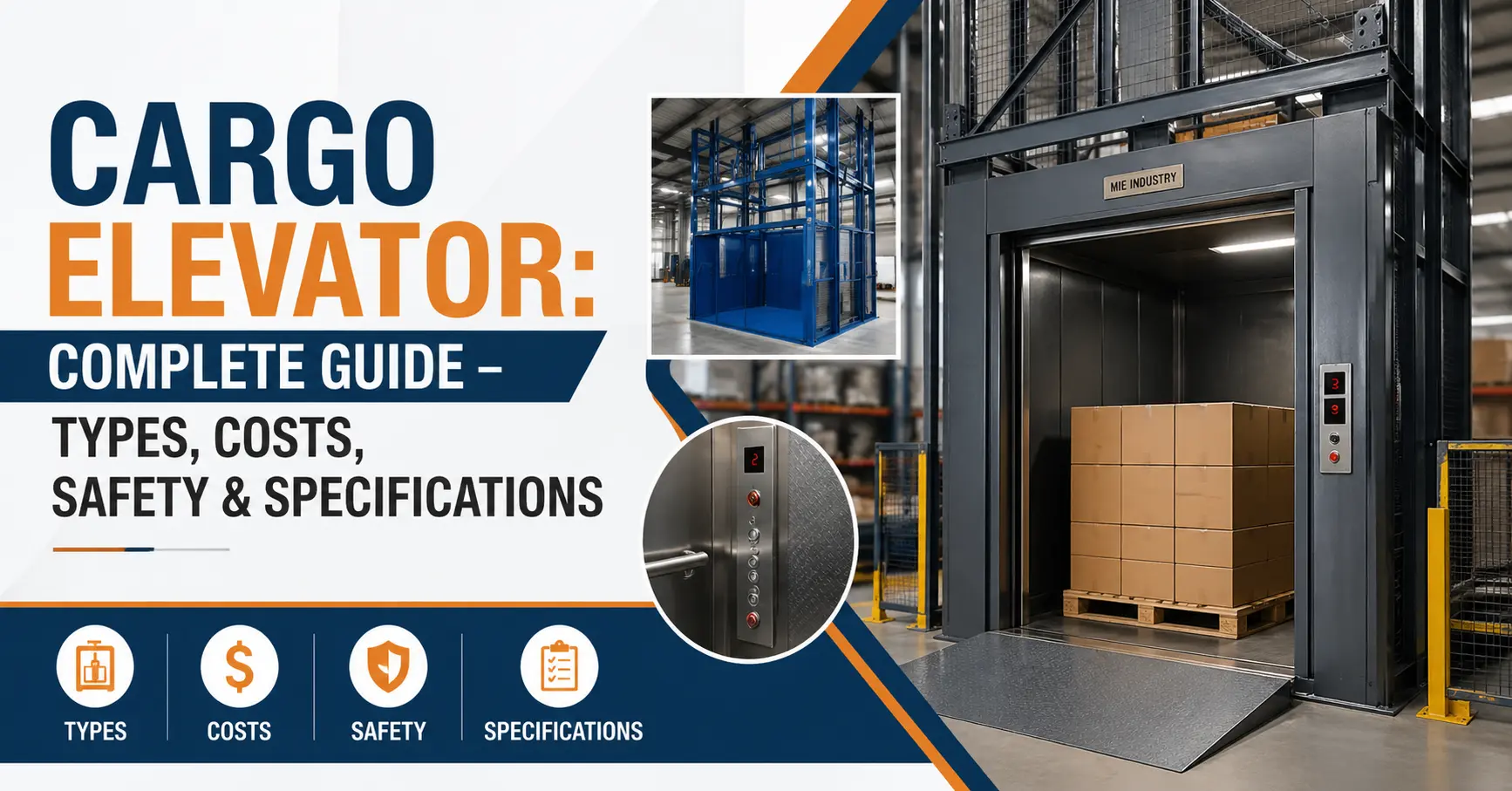
Cargo Elevator: The Complete Guide to Types, Classes, Costs & Safety Standards (2026)
Quick Answer: What Is a Cargo Elevator?
A cargo elevator (also known as a freight elevator, goods lift, or service elevator) is a vertical transport system engineered specifically to move goods, materials, pallets, forklifts, and heavy equipment between building floors. Unlike passenger elevators that prioritize aesthetics and comfort, cargo elevators are built for maximum load capacity, structural durability, and operational efficiency. They are governed by the ASME A17.1-2025 Safety Code and classified into five loading classes (A through E) based on load type and loading method. Capacities range from 2,000 lbs to 50,000+ lbs, and installation costs span from $5,000 to $300,000+ depending on type, capacity, and building conditions.
1. What Is a Cargo Elevator? Definition, History & Core Concepts
A cargo elevator is a purpose-built vertical conveyance system designed to transport heavy goods, raw materials, finished products, vehicles, and industrial equipment between different floor levels within a building or structure. The terms freight elevator, cargo elevator, goods lift (UK English), and service elevator are largely interchangeable in the industry, all referring to the same category of heavy-duty lifting equipment.
Conceptually, the freight elevator is the original elevator. Historical records suggest the ancient Egyptians used rope-and-pulley systems to move construction materials during the building of the pyramids, and Greek mathematician Archimedes documented a primitive freight elevator concept as early as 236 B.C. The modern era of cargo elevators began in earnest with Elisha Graves Otis, whose 1854 Crystal Palace demonstration showcased a safety brake on a freight platform — the famous moment that made tall industrial buildings commercially viable.
In modern industrial and commercial settings, cargo elevators are the backbone of vertical logistics. A single freight elevator in a busy distribution center may complete 100–200 trips daily, moving between 50,000 and 100,000 pounds of goods every day. Over a 20-year service life, such a unit can transport an estimated 300–500 million pounds of cargo.
Cargo Elevator vs. Passenger Elevator: Key Differences
| Feature | Cargo Elevator | Passenger Elevator |
|---|---|---|
| Primary Purpose | Move goods, pallets, equipment | Move people between floors |
| Capacity Range | 2,000 – 50,000+ lbs | 1,000 – 4,000 lbs typical |
| Interior Finish | Rugged steel, crash strips, painted panels | Decorative panels, mirrors, flooring |
| Door Type | Manual, bi-parting, telescopic (wide opening) | Automatic, center-opening |
| Speed | Slower (prioritizes safety) | Faster (prioritizes efficiency) |
| Regulatory Class | ASME A17.1 Classes A–E | ASME A17.1 passenger code |
| Installation Cost | $5,000 – $300,000+ | $60,000 – $90,000 (basic) |
| Min. Cab Height | 8 ft (2.4 m) | 7 ft (2.1 m) |
2. Types of Cargo Elevators: A Complete Classification
Understanding the different types of cargo elevators is critical for selecting the right solution for your facility. Each type is engineered for specific operational demands, building heights, load profiles, and budget constraints.
2.1 Hydraulic Cargo Elevator
Hydraulic freight elevators use a pump-driven cylinder mechanism to push hydraulic fluid (oil-based or vegetable-based) under pressure, raising the platform smoothly and quietly. They are the dominant solution for low-rise applications of 2–6 floors, valued for their simple construction, lower installation cost, and excellent load-handling capability.
Key safety features unique to hydraulic cargo elevators include: spillover valves to prevent high pressure during ascent, manual emergency valves for descent to the nearest floor during power outages, manual pump backups, and pipe fracture valves that automatically cut hydraulic flow if a line ruptures — preventing uncontrolled platform descent.
2.2 Traction Freight Elevator
Traction freight elevators use a system of steel wire ropes and counterweights driven by an electric motor. This configuration makes them substantially more energy-efficient than hydraulic systems and well-suited for high-rise buildings or facilities requiring heavy-duty lifting across many floors. The counterweight — typically 40–50% of the rated load plus the empty car weight — significantly reduces the motor power required for each lift cycle.
2.3 Machine-Room-Less (MRL) Cargo Elevator
MRL freight elevators integrate the drive machinery within the hoistway shaft itself, eliminating the need for a dedicated overhead or adjacent machine room. This design saves significant floor space and offers more flexible installation options — making MRL elevators popular in buildings where space is at a premium. They can exceed $180,000 installed but offer long-term operational advantages.
2.4 Vertical Reciprocating Conveyor (VRC / Material Lift)
VRCs, also called material lifts or mezzanine lifts, are not technically elevators under the ASME A17.1 code — they are governed separately as industrial equipment. They transport goods vertically on an open platform, typically in manufacturing and warehousing environments, and are not permitted to carry passengers under any circumstances. Available in two-post (wall-mounted) and four-post configurations, VRCs are often the most economical entry point for vertical goods movement.
2.5 Vehicle / Car Elevator
Specialized cargo elevators designed to transport automobiles, trucks, and other wheeled vehicles between floors. Commonly found in multi-story parking garages, car dealerships, automotive service facilities, and dense urban areas where ramped parking is not feasible. Mostly hydraulic-drive with typical weight capacities of 2 tons for standard vehicles, rising significantly for heavier commercial vehicles.
2.6 Special-Purpose Cargo Elevators
Beyond standard types, specialized variants serve demanding environments:
- Explosion-proof freight elevators — for chemical plants, refineries, and flammable material storage
- Cleanroom freight elevators — for pharmaceutical and semiconductor manufacturing environments
- Cold-chain freight elevators — insulated and temperature-controlled for food and pharmaceutical cold storage
- Exterior / outdoor cargo elevators — weatherproofed with heated hoistways, corrosion-resistant finishes, and wind-load engineering; cost 25–40% more than interior equivalents
- Livestock elevators — veterinary and agricultural applications with specialized flooring and containment
3. ASME Freight Elevator Load Classes: A Through E Explained
The American Society of Mechanical Engineers (ASME) A17.1-2025 Safety Code for Elevators and Escalators — the 24th edition of the code, covering design, construction, installation, operation, testing, inspection, maintenance, and repair — establishes five loading classifications for freight elevators. Selecting the correct load class is a foundational safety and compliance decision; misclassification can lead to structural failure, regulatory penalties, and voided insurance.
| Class | Name | Loading Method | Key Rule | Typical Use |
|---|---|---|---|---|
| Class A | General Freight | Hand-loaded or hand-truck | No single piece > 25% of rated capacity | General warehouses, retail stockrooms |
| Class B | Motor Vehicle | Vehicle driven or rolled in | Combined weight of vehicle + load ≤ rated capacity | Parking garages, car dealerships |
| Class C1 | Industrial Truck (Truck Remains) | Industrial/forklift truck loads & stays in elevator | Truck + load combined ≤ rated capacity; truck may stay during operation | Warehouses with forklift operation |
| Class C2 | Industrial Truck (Truck Removed) | Forklift loads freight, then exits before operation | During loading/unloading, platform may bear up to 150% of rated capacity; truck must exit before elevator moves | Distribution centers, manufacturing plants |
| Class C3 | Heavy Concentrated Loading | Static concentrated load | Static weight during loading ≤ rated load; no forklift remains | Industrial plants with dense, heavy equipment |
4. Cargo Elevator Technical Specifications & Dimensions
Cargo elevator dimensions and technical parameters vary significantly by load class and application. The following benchmarks represent standard industry values for planning and procurement purposes. Custom configurations are widely available from manufacturers.
Door Configuration by Size
Door configuration scales with elevator size and capacity. Small freight elevators commonly use center-opening or two-speed sliding telescopic doors. Larger models use three or four sliding telescopic panels. Very large or heavy-duty freight elevators — up to 7,000 kg capacity — may use six-sliding telescopic doors. Older American and Hong Kong installations frequently feature two vertical sliding doors, either manual or automatic.
| Capacity Class | Door Type | Opening Width | Special Notes |
|---|---|---|---|
| Light-duty (<2,000 kg) | 2-speed center-opening telescopic | 900–1,200 mm | Suitable for mezzanines & light industrial |
| Standard (2,000–4,500 kg) | 3-speed telescopic or bi-parting | 1,200–2,000 mm | Most common commercial configuration |
| Heavy-duty (4,500–7,000 kg) | 4–6 speed telescopic | 2,000–3,000 mm | Allows forklift access with load |
| Super heavy (>7,000 kg) | Custom bi-parting or vertical sliding | 3,000 mm+ | Custom engineering required |
5. Cargo Elevator Cost: Complete Pricing Guide for 2025
Cargo elevator installation costs are among the most significant capital expenditures in a facility buildout or renovation. Prices are influenced by type, capacity, number of floors, structural requirements, local labor rates, and permitting. The following benchmarks reflect 2025 U.S. market conditions.
Cost by Elevator Type
Hidden & Additional Cost Factors
The base equipment price is rarely the final number. Budget for the following additional expense categories:
| Cost Factor | Typical Impact | Notes |
|---|---|---|
| Hoistway / Structural Reinforcement | $10,000–$80,000+ | Required for heavy Class C installations with steel-reinforced concrete walls |
| Electrical Service Upgrade | $5,000–$25,000 | Heavy-duty units may require 200–400 amps at 480 volts dedicated service |
| Permits & Inspections | $1,500–$10,000 | Varies by jurisdiction; annual inspection required post-installation |
| Pit Excavation | $3,000–$15,000 | If existing slab must be broken; some hydraulic models require only 200–250mm pit |
| Machine Room Construction | $5,000–$20,000 | Not required for MRL or VRC; required for traditional traction elevators |
| Annual Maintenance Contract | $1,500–$8,000/yr | Industry experts recommend at minimum twice-yearly service visits |
6. Industry Applications of Cargo Elevators
Cargo elevators serve critical operational roles across virtually every sector of the industrial and commercial economy. The right selection depends on industry-specific load profiles, operational frequency, regulatory environment, and building design.
| Industry / Setting | Primary Use | Recommended Type | Typical Capacity |
|---|---|---|---|
| Warehouses & Distribution Centers | Moving pallets, containers, bulk goods between mezzanine and floor levels | Class C1/C2 Hydraulic or Traction | 5,000–15,000 lbs |
| Manufacturing Plants | Inter-floor movement of raw materials, WIP (work-in-progress), finished goods | Traction or MRL; Class C | 5,000–20,000 lbs |
| Hospitals & Healthcare | Medical equipment, laundry, food service, pharmacy supplies | Class A Hydraulic; cleanroom-capable | 2,000–5,000 lbs |
| Restaurants & Hotels | Food service, linen, back-of-house logistics between kitchen and serving floors | Small hydraulic goods lift | 500–2,000 lbs |
| Retail Stores | Stock movement from loading dock to sales floor storage | Class A Hydraulic | 2,000–6,000 lbs |
| Automotive & Car Dealerships | Vehicle storage, service bay access, parking | Class B Vehicle Elevator | 4,000–10,000 lbs |
| Cold Storage / Food Logistics | Temperature-sensitive goods between cold storage levels | Cold-chain freight elevator | 3,000–8,000 lbs |
| Steel Mills & Heavy Industrial | Heavy machinery, coils, plates, industrial components | Class C3 custom traction | 20,000–50,000 lbs |
| Residential (Multi-Family) | Furniture, appliances, groceries in high-rises | Small hydraulic or VRC | 500–2,000 lbs |
| Mezzanines & Racking Systems | Pick-and-pack operations between ground floor and mezzanine storage | VRC / Two-post cargo lift | 1,000–6,000 lbs |
7. Cargo Elevator Safety Standards & Compliance Requirements
All cargo elevators installed in the United States must comply with a comprehensive framework of federal, national, and local safety standards. Non-compliance can result in facility shutdowns, regulatory fines, voided insurance, and most importantly, serious injury or fatality risk.
Governing Standards
- ASME A17.1-2025 — Safety Code for Elevators and Escalators (24th edition). Covers design, construction, installation, operation, testing, inspection, maintenance, alteration, and repair. The 2025 edition adds requirements for emergency responder radio coverage, elastomeric buffers, and updated seismic requirements.
- ASME A17.3-2023 — Safety Code for Existing Elevators and Escalators. Governs retroactive requirements for installations predating the current A17.1 edition.
- OSHA 29 CFR Part 1910 — U.S. Occupational Safety and Health Administration regulations covering freight elevator operation in workplaces.
- ASME A17.5-2025 — Electrical Equipment Standard for Elevators and Escalators. Must be used in conjunction with NFPA 70 (National Electrical Code).
- EN 81-20 (European) and GB 7588 (China) — equivalent international standards governing cargo elevator design and safety for non-US markets.
Required Safety Features
All compliant freight elevators must be equipped with the following minimum safety systems:
8. Cargo Elevator Installation Process
The installation of a cargo elevator is a multi-phase process involving structural engineering, electrical systems, mechanical installation, regulatory inspection, and commissioning. Understanding the timeline and stakeholders helps facilities plan effectively and avoid costly delays.
Phase-by-Phase Installation Workflow
| Phase | Activity | Typical Duration | Key Stakeholders |
|---|---|---|---|
| 1. Site Assessment | Structural survey, load calculations, hoistway dimensioning, electrical audit | 1–2 weeks | Structural engineer, elevator consultant |
| 2. Permitting | Building permit, elevator installation permit, electrical permit submission | 2–8 weeks | AHJ (Authority Having Jurisdiction), local building department |
| 3. Hoistway Construction | Pit excavation (if required), hoistway framing or concrete work, structural reinforcement | 1–4 weeks | General contractor, structural engineer |
| 4. Mechanical Installation | Rail installation, machine/drive system, car platform assembly, door systems | 1–3 weeks | Licensed elevator mechanic / contractor |
| 5. Electrical & Controls | Power supply connection, control panel wiring, safety circuit testing, PLC programming | 3–7 days | Licensed electrician, elevator technician |
| 6. Testing & Inspection | Load testing to rated capacity, safety device testing, code compliance inspection by AHJ | 1–3 days | AHJ inspector, ASME-certified inspector |
| 7. Commissioning & Training | Operator training, documentation handover, warranty activation | 1 day | Manufacturer/installer, facility manager |
For residential cargo lift installations, most units can be installed within 2 to 5 days after permits and site assessment are completed. Commercial and industrial installations with structural reinforcement requirements typically span 6–16 weeks from project kick-off to commissioning.
9. Maintenance, Service Life & Long-Term Care
A well-maintained cargo elevator is designed to provide reliable service for 25 years or more. Industry experts recommend a minimum service frequency of twice per year, though heavy-use installations in distribution centers and manufacturing plants benefit from quarterly or monthly inspections.
Preventive Maintenance Checklist
- Lubrication — Rail guides, drive sheaves, and chain mechanisms require periodic lubrication with appropriate-grade lubricants (synthetic fluids for outdoor/temperature-variable installations)
- Hydraulic System Inspection — Check oil level, fluid condition, cylinder integrity, hose condition, and valve operation; flush and replace hydraulic fluid per manufacturer schedule
- Safety Device Testing — Verify operation of overload sensors, limit switches, door interlocks, emergency lighting, and governor/brake systems
- Rope / Cable Inspection — For traction elevators, inspect suspension ropes per ASME A17.6 criteria for wire breakage, corrosion, and diameter reduction
- Door System Inspection — Check door panels, tracks, interlocks, and closure speed for smooth, safe operation
- Annual Load Testing — Many jurisdictions require annual or periodic load testing by an ASME-certified inspector as a condition of operating permit renewal
10. How to Choose the Right Cargo Elevator: Buyer’s Guide
Selecting the optimal cargo elevator for your facility requires systematic evaluation across six key decision dimensions. Use this framework before engaging any manufacturer or contractor.
| Decision Factor | Questions to Answer | Impact on Selection |
|---|---|---|
| Load Capacity | What is the maximum single-load weight? Will forklifts remain in the elevator? | Determines load class (A–E) and structural requirements |
| Building Height / Floors | How many floors? What is the total travel distance? | Low-rise (2–6 floors) → hydraulic; high-rise → traction or MRL |
| Platform Dimensions | What is the largest item to be transported? Are pallets/forklifts involved? | Determines minimum cab width, depth, and door opening size |
| Usage Frequency | How many trips per day/hour? Is it continuous or intermittent operation? | High-frequency use requires traction or MRL over hydraulic |
| Available Space | Is a machine room feasible? How deep can the pit be? | Space constraints may mandate MRL, VRC, or shallow-pit hydraulic |
| Budget & Lifecycle Cost | What is the upfront vs. 10-year total cost of ownership? | Hydraulic has lower CAPEX; traction/MRL lower operating cost over time |
| Regulatory Environment | What special standards apply? (food safety, pharmaceutical, hazardous materials?) | May require explosion-proof, cleanroom, or cold-chain specialized units |
11. Frequently Asked Questions About Cargo Elevators
Conclusion: Making the Right Cargo Elevator Decision
A cargo elevator is a long-term capital investment that directly impacts the operational efficiency, safety, and regulatory compliance of your facility. Whether you are outfitting a new warehouse, upgrading a manufacturing plant, or adding a goods lift to a multi-story retail building, the decision framework is the same: match load class to actual operational demands, select the drive type appropriate for your building height and usage frequency, and insist on full ASME A17.1 compliance.
With proper selection, professional installation, and biannual maintenance, a quality cargo elevator will reliably serve your facility for 25 years or more — delivering a compelling return on investment through productivity gains, injury reduction, and operational continuity.
Related Topics & Semantic Entities