MIEUSER
24 April 2026
0 Comments
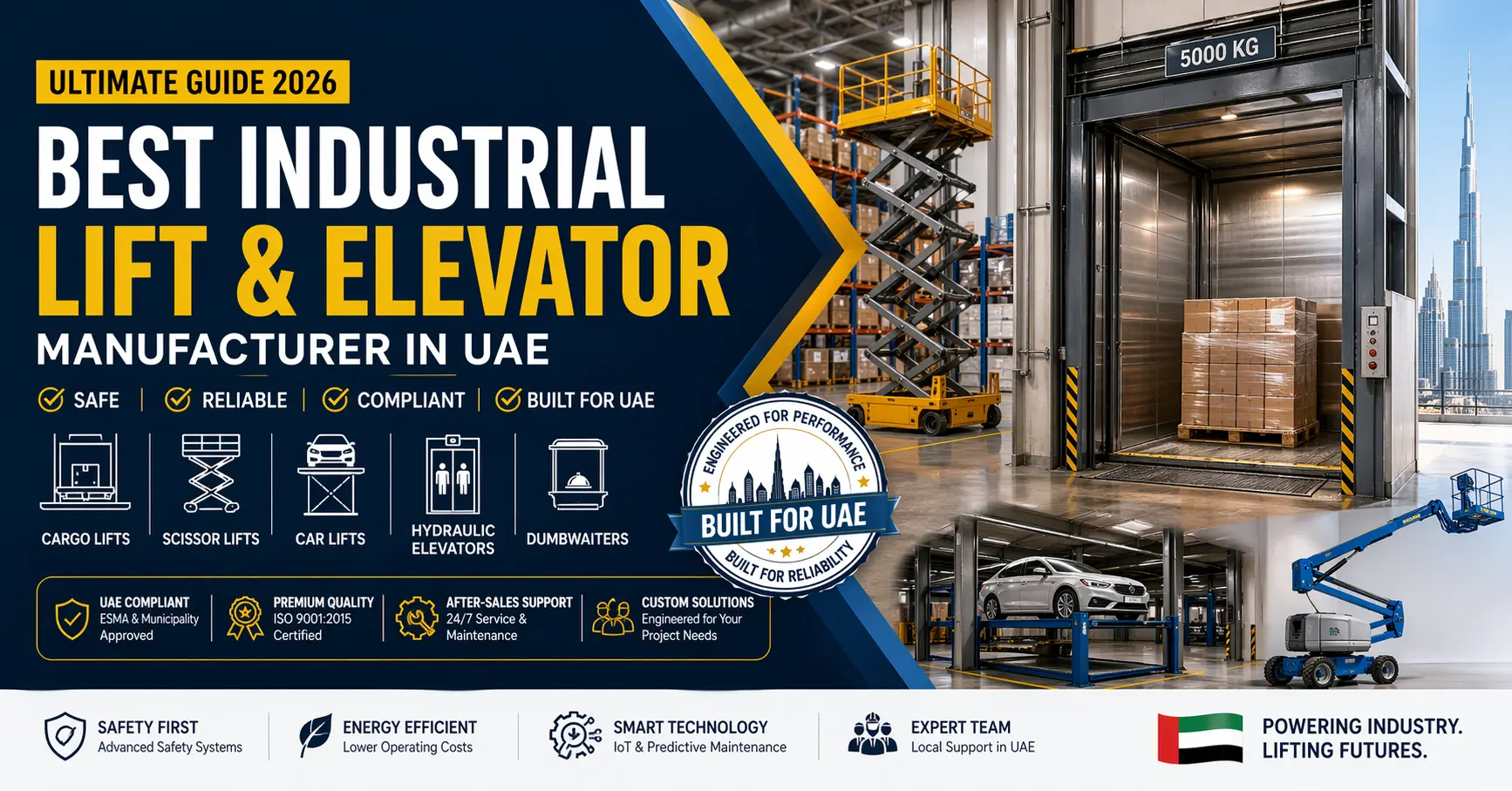
Best Industrial Lift & Elevator Manufacturer In UAE
The stakes are high if you’re looking for an industrial lift or elevator for a project in the United Arab Emirates. Making the incorrect decision results in downtime, safety hazards, and expensive replacements. Making the proper decision will result in years of dependable, legal, and effective operation in one of the most demanding industrial settings on the planet.The types of lifting systems available, what distinguishes trustworthy manufacturers from untrustworthy ones, UAE-specific compliance standards, actual cost benchmarks, and questions to ask before signing any contract are all covered in this book to help you make an informed and confident choice.For whom this tutorial is intended: Industrial lifting solutions are sought after by procurement managers, facility engineers, warehouse operators, building project leads, and business owners throughout the United Arab Emirates.Why the UAE Industrial Lift Market Is Unique
No other market can nearly match the operating circumstances that the UAE offers. Prior to choosing any lifting system, decision-makers must comprehend the unique challenges of this environment and the reasons why not all worldwide manufacturers are prepared to meet its needs.Extreme Environmental Conditions
The UAE frequently experiences summer temperatures above 45°C and significant humidity in coastal areas like Dubai and Abu Dhabi. Sand penetration, salt-laden air, and dust storms are ongoing dangers to electrical and mechanical systems. Any industrial lift used here needs to be designed with these facts in mind, not just modified after the fact.Heat-resistant fluid compositions are necessary for hydraulic systems. IP54 or higher seals are required for control panels. Corrosion-resistant coatings are necessary for steel components. Manufacturers will create equipment that breaks down too soon in UAE conditions if they don’t take these details into consideration during the design phase.Regulatory Complexity
The United Arab Emirates has two regulatory frameworks. The Emirates Authority for Standardization and Metrology (ESMA) sets baseline standards at the federal level. Organizations such as the Department of Municipalities and Transport in Abu Dhabi and Dubai Municipality enforce some building and safety requirements at the emirate level. Equipment used in free zones such as Jebel Ali, KIZAD, or Dubai South may be subject to additional compliance requirements pertaining to zone-specific regulations.Rapid Infrastructure Growth
Over thirty million square meters have been added to the UAE’s logistics and warehouse space in the past ten years. Mega-projects like Expo City, District 2020, and the development of Al Maktoum International Airport have increased demand for vertical transportation solutions. Delivery schedules and the efficiency of on-site installation are now just as important as the product’s real quality because of how quickly projects must be completed.Workforce and Labour Considerations
Because industrial sites employ a significant number of foreign workers, lift systems need to have user-friendly controls, clear multilingual labeling, and dependable safety interlocks. Operator training materials in Arabic, English, Hindi, and Urdu are becoming required of serious providers. Complete Guide to Industrial Lift Types in UAEChoosing the wrong lift type is one of the most common and costly mistakes in UAE industrial procurement. Each system is engineered for a specific load profile, frequency of use, and operational context. Here is a detailed breakdown:Cargo Lifts (Goods Lifts)
The mainstay of UAE logistics and warehousing is the cargo lift. They are the preferred option for multi-story distribution centers, manufacturing facilities, and industrial storage facilities since they are made to move huge items between floors, usually weighing between 500 and 10,000 kg.Important criteria to assess:- Capacity to load: With a 20% safety margin, match to your largest pallet or equipment load.
- Platform dimensions: If mechanical loading is necessary, it must fit your forklift model.
- Door types that fit various floor plans include horizontal sliding, vertical rising, and bi-folding.
- Duty cycle: Use heavy-duty motors and strengthened wires for high-frequency operations (50 cycles or more per day).
- System of control: PLC-based automation with call stations on every floor versus basic push-button automation
Hydraulic Elevators
Hydraulic elevators raise and lower the cabin using a fluid-powered piston system. When smooth, slow-speed movement is needed in low- to medium-rise applications (up to six stories), they are very well praised.Hydraulic systems have a significant benefit in the UAE since they don’t need a machine room above the shaft, which makes them perfect for structures with limited rooftop space. Because their fall is independent of active power after the valve is opened, they also function dependably in situations including power fluctuations.Considerations for maintenance: High ambient temperatures must not be a problem for hydraulic fluid. Given the climate in the United Arab Emirates, schedule annual seal inspections and quarterly fluid checks.Best suited for: Low-rise commercial buildings, car showrooms, factories with ground floor to mezzanine movement, healthcare facilities.Scissor Lifts
Scissor lifts are either stationary or mobile platforms that offer steady, regulated vertical elevation by means of a crisscrossing metal support framework. They are work platforms used to raise people and equipment for maintenance, installation, or overhead tasks; they are not transport lifts in the conventional sense.Diesel versus electric scissor lifts: Because electric variants emit no pollutants, they are favored for interior UAE applications. On open construction sites, diesel models are utilized. Electric variants also have the advantage of producing less noise in the UAE’s indoor industrial settings, which is important in occupied buildings.Working height, platform extension reach, and maximum load are important specifications. When deploying on mezzanine floors, always check the ground bearing pressure.Car Lifts and Automated Parking Systems
The UAE’s rapid urbanisation particularly in Dubai, Sharjah, and Abu Dhabi has created intense demand for space-efficient vehicle parking solutions. Car lifts are deployed in basement parking facilities, multi-storey car parks, and private villas.Types include:- Four-post vehicle lifts: Usually able to handle loads of 3,000–5,000 kg for maintenance and storage
- Scissor-style automobile platforms: Small footprint, perfect for moving from the basement to the ground floor
- Car turntables are crucial for limited basement layouts in the United Arab Emirates because they let cars depart forward.
- Automated multi-story parking systems are becoming more and more common in upscale residential and commercial complexes in the United Arab Emirates. These fully automated systems park and retrieve cars without the need for drivers.
Boom Lifts (Aerial Work Platforms)
Boom lifts, also known as aerial work platforms (AWPs), are widely utilized for facility maintenance on high-rise buildings and on construction sites throughout the United Arab Emirates. They are particularly well-suited for activities that scissor lifts cannot access because they offer both vertical height and horizontal reach.Telescopic boom lifts can reach higher heights in a straight line, whereas articulating boom lifts can maneuver around obstructions. Both are used in the UAE building industry, with high-rise projects often using working height models of 30 to 50 meters.Dumbwaiters (Food and Service Lifts)
Small-capacity vertical conveyors called dumbwaiters are used to move food, paperwork, laundry, and other small items between floors. Food-grade dumbwaiters are in high demand due to the UAE’s thriving hospitality industry, which comprises hundreds of hotels, restaurants, and resorts.Crucial requirements for hospitality developments in the United Arab Emirates: For hotel kitchen applications, stainless steel interiors, food-safe surface coatings, and quiet operation (below 55 dB) are essential. Verify that the model conforms with UAE food safety laws (ESMA/HACCP requirements, when applicable).Vertical Platform Lifts (Accessibility Lifts)
In the UAE, vertical platform elevators fulfill an expanding accessibility mandate. Accessibility compliance in public buildings is mandated by Federal Law No. 29 of 2006 concerning the Rights of People with Disabilities. When full shaft construction is not practical, vertical platform lifts offer an elevator-like solution.Important: In terms of shaft enclosure and emergency lowering in the event of a power outage, these lifts must adhere to the UAE Fire and Life Safety Code of Practice.UAE Safety Standards & Compliance RequirementsCompliance is not a box-ticking exercise in the UAE it is a procurement prerequisite. Understanding which certifications matter, and why, protects your business from regulatory shutdowns, insurance voidance, and liability exposure.Mandatory Certifications to Require from Any Manufacturer
| Certification | What It Covers | Why It Matters in UAE |
| CE Marking | European safety, health, and environmental protection standards | Widely accepted by UAE regulatory authorities as baseline proof of compliance |
| ISO 9001:2015 | Quality management system certification | Demonstrates consistent manufacturing quality and process control |
| EN 81 / ASME A17.1 | Safety rules for the construction and installation of elevators | Referenced by Dubai Municipality for elevator approvals |
| SIL Certification | Safety Integrity Level for safety-critical control systems | Required for lifts used in oil, gas, and chemical facilities |
| ESMA Registration | UAE federal product conformity mark | Required for products sold in the UAE market |
Dubai Municipality Elevator Regulations
Elevator capacity, speed, and safety system requirements vary depending on the kind of building and occupancy, according to Dubai Municipality’s Building Regulations and Requirements document. Emergency lights within cabins, overload protection, door reopening mechanisms, and adherence to public building accessibility regulations are essential needs.Any manufacturer should provide a Compliance Declaration to procurement teams working on Dubai projects, attesting to the equipment’s compliance with current Dubai Municipality regulations.Abu Dhabi Regulatory Framework
The Department of Municipalities and Transport (DMT) in Abu Dhabi uses its building permit system to enforce elevator rules. Before any lift is put into service in a newly constructed or substantially renovated structure, a third-party inspection by an authorized inspection organization like Bureau Veritas, SGS, or Intertek is usually necessary.Periodic Inspection Requirements
In the UAE, industrial lifts must go through regular safety checks when they are installed. The majority of cargo and passenger lifts are required to undergo an annual inspection, though the frequency varies by emirate. Insurance validity and operational legal compliance depend on keeping an up-to-date inspection certificate.4. How to Evaluate and Choose a Manufacturer
Suppliers in the UAE market range from local vendors that resale imported equipment without technical assistance to internationally recognized producers with direct factory operations. Your money is protected if you know how to differentiate between them.Factor 1: Direct Manufacturing vs. Trading
From sourcing raw materials to final assembly, quality assurance, and testing, a direct manufacturer has complete control over the production process. This entails complete traceability, the ability to customize, and constant quality. A trader buys from independent manufacturers and resells, frequently with little capacity to alter specifications, supply long-term spare parts, or provide true technical assistance.How to confirm: For independent verification, ask for factory audit results, ISO 9001 scope documentation (which should mention manufacturing, not simply trading), and factory address.Factor 2: Customisation Capability
Standard catalogue criteria are rarely met by UAE projects. You might require a bespoke lifting height to meet your mezzanine level, a non-standard platform size to fit your particular forklift model, or a specific control interface to integrate with your warehouse management system.Instead of just using the closest stock models, a competent manufacturer should be able to show prior custom constructions, give technical drawings upon request, and provide a proper customization quote procedure.Factor 3: Project Track Record and References
Ask for a list of client references unique to the GCC or UAE. A manufacturer’s real-world capabilities is best demonstrated by completed projects in equally challenging situations, such as high ambient temperatures, continuous operation needs, and rigorous compliance contexts.Questions to pose to references: Was the delivery made on schedule? Were the teams responsible for installation competent? How soon were post-installation problems fixed? Do spare parts come from overseas or are they available locally?Factor 4: After-Sales Infrastructure
A long-term asset is an industrial elevator. Preventive maintenance programs, local technical assistance, and the availability of spare parts are crucial to the overall lifetime cost. Compared to manufacturers who solely sell and ship, those who have a UAE service presence, either directly or through an authorized service partner, are much less risky.Prior to buying, be clear: How long will spare parts be available for sure? Is there an emergency breakdown service available around-the-clock? What are the UAE’s pledges regarding response times?Factor 5: Financial Stability and Longevity
There is a significant operational risk when purchasing from a manufacturer that ends operations in the third year of a ten-year lift lifespan. Ask for proof of continuous R&D investment, years of operation, and firm registration documents. Compared to newer, unidentified suppliers who compete only on price, established manufacturers with a track record spanning several decades pose a significantly lesser risk.Warning Signs:- No ISO 9001 certificate or CE marking is available upon request.
- Unwillingness to give audit reports or access for factory inspections
- Uncertain or nonexistent warranty conditions
- No designated technical contact or local presence in the UAE
- Pricing that is noticeably below market and lacks a clear cost structure explanation
- Not being able to supply load calculations or engineering drawings
- Cost of Industrial Lifts in UAE: Real Benchmarks
| Lift Type | Capacity Range | Indicative Price Range (USD) | Key Cost Variables |
| Cargo Lift (basic) | 500–2,000 kg | $8,000 – $25,000 | Platform size, number of floors, door type |
| Cargo Lift (heavy duty) | 2,000–10,000 kg | $25,000 – $85,000 | Load capacity, automation level, custom dimensions |
| Hydraulic Elevator | Standard | $15,000 – $45,000 | Floors served, cabin finish, speed |
| Scissor Lift (stationary) | 1,000–5,000 kg | $5,000 – $20,000 | Platform size, lifting height, surface finish |
| Car Lift (4-post) | 3,000–5,000 kg | $6,000 – $18,000 | Runway length, hydraulic vs. electric, finish |
| Dumbwaiter | 50–300 kg | $3,000 – $9,000 | Number of stops, interior material, speed |
| Automated Parking System | Multi-car | $50,000 – $500,000+ | Capacity, footprint, control sophistication |
Understanding the True Cost of Ownership
The purchase price is just one part of the whole expense. A thorough assessment ought to comprise:- Costs of installation: Electrical supply, control wiring, and shaft/pit civil construction often add 15–30% to the cost of the equipment.
- Annual maintenance: The average annual cost of preventive maintenance contracts is between three and six percent of the equipment’s worth.
- Inspection and certification: Depending on the type of lift, annual third-party inspection fees in the UAE range from AED 500 to AED 5,000.
- Energy expenses: Over the lift’s lifetime, higher-efficiency motors (IE3 class) cut electricity use by 20–30%.
- Spare parts: Verify the cost and availability of crucial worn parts, control boards, cables, seals, and bearings.
Factory-Direct vs. Distributor Pricing
Equipment costs can be lowered by 20–40% by buying directly from a manufacturer as opposed to using a local trading middleman. However, as the buyer bears additional responsibility for compliance documentation, warranty terms, and after-sales support agreements in the absence of a local distributor relationship, direct buying necessitates more due diligence.Industry-Specific Lift Requirements in UAE
Warehousing and Logistics
High-capacity cargo lifts that can run continuously for three shifts are required by the UAE’s storage industry, which is anchored by Dubai Logistics City, Jebel Ali Port, and the expanding KIZAD complex in Abu Dhabi. Forklift-accessible platforms (minimum 2.5 x 3.5 m for standard forklifts), heavy-duty doors rated for frequent cycling, and PLC-based controls compatible with warehouse management systems are important requirements.Construction and Contracting
Both temporary and permanent lifting systems are used in UAE construction projects. During the construction phase, construction hoists facilitate the transfer of temporary workers and materials. For continuous maintenance access in high-rise structures, permanent service elevators are provided. Throughout the building lifespan, scissor lifts and boom lifts are utilized to complete tasks at heights.Manufacturing and Industrial Plants
Lifts are used by manufacturing companies in the Sharjah and Ras Al Khaimah industrial zones of the United Arab Emirates for both vertical material flow and equipment maintenance. Process lifts that are intended to manage high temperatures, chemical exposure, or cleanroom standards require particular engineering and material parameters that go beyond those of typical catalog goods.Oil, Gas and Petrochemical
Lifting equipment that is explosion-proof (ATEX-certified) is required at sites operated by ADNOC and its affiliated firms throughout the United Arab Emirates. Lifts used in dangerous areas need to be SIL certified, have an ATEX Zone classification, and be maintained by qualified individuals. Only a few producers in this highly specialized market have the required certification portfolio.Hospitality and Hotels
Mega-malls and mixed-use complexes in the United Arab Emirates necessitate a mixture of car park lifts for vehicle access and goods lifts for stock transportation. These installations function in highly visible, public spaces where low downtime, dependability, and aesthetics are crucial success elements.Healthcare and Hospitals
Healthcare facility guidelines and relevant infection control requirements must be followed by hospital lifts in the United Arab Emirates. Stainless steel interiors, antimicrobial surface coatings, and special ventilation features are necessary for stretcher lifts, bed lifts, and clinical goods lifts. For hospital installations, the lift manufacturer is required to supply complete material certifications.Retail and Mixed-Use Developments
The UAE’s mega-malls and mixed-use developments require a combination of goods lifts for stock movement and car park lifts for vehicle access. These installations operate in high-visibility, public-facing environments where aesthetics, reliability, and minimal downtime are critical success factors.What the Installation Process Should Include
A professional industrial lift installation in the UAE should follow a structured process that protects the buyer at every stage:- Site survey and civil requirement documentation: Before equipment order, the manufacturer should conduct a detailed site survey and provide pit depth, headroom, and structural load specifications for civil works
- Permit and approvals coordination: The supplier or their local representative should assist with or handle municipal permit applications
- Equipment delivery and pre-installation inspection: All components should be inspected for transit damage before installation commences
- Supervised installation by trained technicians: Factory-trained or certified installation teams not generic subcontractors
- Load testing and commissioning: Full load test at 125% of rated capacity, with documented test report
- Regulatory inspection and certification: Third-party inspection by an approved body before handover
- Operator training: Hands-on training for your team on daily operation and basic safety checks
Preventive Maintenance Best Practice in UAE Conditions
Several lift components experience accelerated wear due to UAE operating conditions. The following should be part of a maintenance schedule suitable for this setting:- Every month: door operation check, control panel inspection, lubrication of guide rails and rollers, and safety interlock testing
- Every three months: brake adjustment, cable tension inspection, hydraulic fluid level and condition check (for hydraulic systems), and load testing
- Every year: Complete electrical system testing, load cell calibration, motor and gearbox maintenance, and full statutory inspection
Spare Parts and Lead Times
Verify that your supplier keeps an inventory of high-wear spare parts in the United Arab Emirates for business-critical applications. Control boards, contactor sets, door locks, and rope/cable sets are common failure areas that should be fixed in 24 to 48 hours. Verify factory lead times for less important components and account for them in your operational continuity strategy.- Future of Industrial Lifts in UAE
IoT-Enabled Predictive Maintenance
IoT-enabled smart lift systems now continuously track load patterns, door cycle counts, vibration signatures, and motor temperature. Predictive maintenance algorithms significantly reduce unnecessary downtime by identifying anomalies before they lead to problems. IoT-connected cargo lifts have already been implemented by a number of UAE logistics companies as part of larger Industry 4.0 warehouse improvements.Energy Efficiency and Sustainability
Procurement decisions are influenced by the UAE’s ambition to reaching net zero by 2050. Increasingly, buyers are requesting LED lighting with occupancy sensors within lift cabins, regenerative braking systems that feed energy back into the building grid, and Variable Frequency Drives (VFDs) on lift motors. Over the course of its operation, these features lower a lift’s energy usage by 30–50%.Automation and WMS Integration
Cargo lifts are being immediately incorporated into warehouse management systems as UAE warehouses implement automated storage and retrieval systems (AS/RS). Without human interaction, lifts can be summoned, sent, and logged automatically, increasing throughput and offering complete audit trails for inventory management.AI-Based Safety Systems
High-value applications are seeing the emergence of sophisticated safety solutions that use AI and computer vision. These systems can identify people or obstacles in the lift path, forecast overload situations based on load distribution trends, and give supervisors real-time safety alarms. Within three to five years, these features should become commonplace in high-end industrial lifts.- Frequently Asked Questions