
Elevator Cargo System: Complete Industrial Guide (2026)
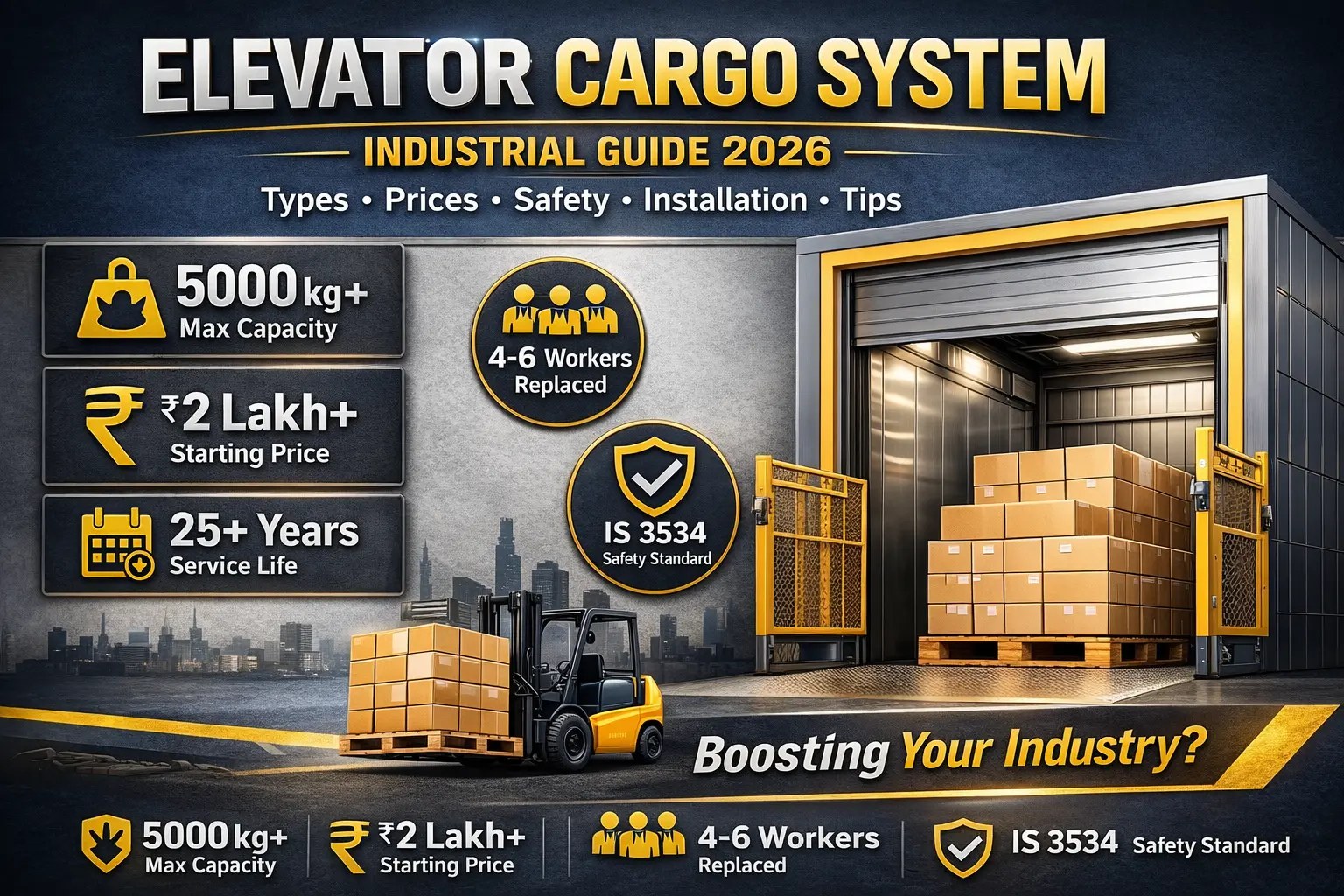
Everything you need to know about elevator cargo systems types, load capacities, safety standards, pricing in India, installation process, and how to choose the right goods lift for your industry.Quick Overview- Max Capacity: 5000+ kg
- System Types: Hydraulic, Traction, Goods Lift, Platform Lift
- Starting Price: ₹2 Lakhs
- Service Life: 20–25 Years
- Primary Use: Industrial & commercial material handling
What Is a Cargo Elevator?
A cargo elevator also known as a goods lift or material hoist is a mechanized vertical transport system designed specifically for moving goods, raw materials, finished products, and industrial equipment between different floors of a building.A cargo elevator is a heavy-duty lifting solution built exclusively for transporting materials (not passengers) in industrial, commercial, and warehousing environments. These systems typically operate using hydraulic mechanisms or traction rope systems, and can handle loads ranging from 500 kg to over 5,000 kg. In India, cargo elevators are designed to comply with safety standards such as IS 3534 (BIS).Unlike passenger elevators, which focus on speed, comfort, and aesthetics, cargo elevators are engineered for:- High load capacity
- Industrial durability
- Resistance to wear and tear
Why Cargo Elevators Are Essential in Modern Industry
Manual handling of heavy goods across floors is one of the leading causes of workplace injuries in India. According to industrial safety data, over 35% of workplace accidents in manufacturing and warehousing are linked to material handling.Installing a cargo elevator system provides:- Improved safety for workers
- Faster material movement
- Increased operational efficiency
- Reduced dependency on manual labor
Types of Cargo Elevators
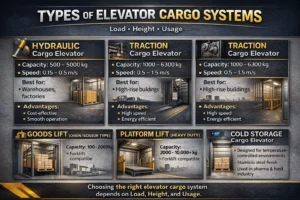 Selecting the right type is critical. Each cargo elevator system has distinct mechanical principles, load capacities, speed capabilities, and ideal use cases.
Hydraulic Cargo Elevator
A hydraulic cargo elevator uses pressurised hydraulic fluid and a cylinder-piston mechanism to raise and lower the platform. It is ideal for low-to-mid-rise buildings handling heavy loads.Load Capacity: 500 kg – 5,000 kg Speed: 0.15 – 0.5 m/s Rise Height: Up to 10 floors Best For: Warehouses, factories, cold storageKey Advantages:- Low Maintenance
- High Load Capacity
- Cost Effective
Traction Cargo Elevator
A traction cargo elevator uses steel ropes and counterweights driven by an electric motor and gearbox. It is best suited for high-rise industrial buildings with continuous heavy-duty operations.Load Capacity: 1,000 kg – 6,300 kg Speed: 0.5 – 1.5 m/s Rise Height: Up to 50+ floors Best For: High-rise industrial buildings, continuous useKey Advantages:- High Speed
- Energy Efficient
- Long Travel Capability
Goods Lift (Scissor / Chain Type)
A goods lift is a compact vertical transport system using scissor-jack or chain-drive mechanisms. It is ideal for small businesses and light industrial use.Load Capacity: 100 kg – 2,000 kg Speed: 0.1 – 0.3 m/s Rise Height: 2–4 floors Best For: Retail shops, restaurants, small factoriesKey Advantages:- Easy Installation
- Low Cost
- Space Saving
Dumbwaiter (Mini Cargo Lift)
A dumbwaiter lift is a small automated system used to transport lightweight items like food, documents, and laundry between floors.Load Capacity: 25 kg – 250 kg Speed: 0.2 – 0.5 m/s Rise Height: 2–10 floors Best For: Hospitals, hotels, restaurants, officesKey Advantages:- Silent Operation
- Fully Automated
- Hygienic Design
Platform / Table Lift
A platform lift is an open-type cargo elevator designed for forklift entry and exit. It is widely used in factories and distribution centers.Load Capacity: 2,000 kg – 10,000+ kg Speed: 0.1 – 0.25 m/s Rise Height: 2–3 floors Best For: Factories, automotive industry, logistics hubsKey Advantages:- Forklift Compatible
- Very High Load Capacity
- Open Platform Design
Cold Storage Cargo Elevator
A cold storage cargo elevator is specially designed for temperature-controlled environments such as food processing units and pharmaceutical warehouses.Load Capacity: 500 kg – 3,000 kg Speed: 0.15 – 0.4 m/s Temperature Range: -25°C to +5°C Best For: Cold chain logistics, pharma warehousesKey Advantages:- Insulated Structure
- Stainless Steel Finish
- Food-Grade & Hygienic
Key Features & Technical Specifications
A well-designed cargo elevator system must balance load capacity, platform size, drive mechanism, and safety features to meet your operational requirements efficiently.Proper specification ensures:- Smooth performance
- Long service life
- Maximum safety
- Cost efficiency
Standard Technical Specifications (2026)
| Parameter | Small Goods Lift | Medium Cargo Elevator | Heavy Industrial Elevator |
| Load Capacity | 500 – 1,000 kg | 1,000 – 3,000 kg | 3,000 – 5,000+ kg |
| Platform Size | 1.5 × 1.5 m | 2 × 2.5 m | 3 × 4 m |
| Speed | 0.15 – 0.3 m/s | 0.25 – 0.5 m/s | 0.5 – 1.0 m/s |
| Drive Type | Hydraulic / Chain | Hydraulic / Traction | Traction / Hydraulic |
| Number of Stops | 2 – 3 | 2 – 6 | 2 – 15 |
| Power Supply | 3-Phase, 415V | 3-Phase, 415V | 3-Phase, 415V |
| Door Type | Manual / Semi-Automatic | Automatic | Automatic / Bi-parting |
| Floor Finish | Chequered Plate | Chequered Plate / Stainless Steel | Chequered Plate / Custom |
Technical Specifications (2026)
| Parameter | Small | Medium | Heavy |
| Capacity | 500–1000 kg | 1000–3000 kg | 3000–5000+ kg |
| Speed | 0.15–0.3 m/s | 0.25–0.5 m/s | 0.5–1 m/s |
| Power | 3 Phase | 3 Phase | 3 Phase |
| Floors | 2–3 | 3–8 | 5–15 |
Industrial
- Manufacturing plants
- Assembly units
Warehousing
- Logistics hubs
- Distribution centers
Commercial
- Shopping malls
- Retail stores
Healthcare
- Hospitals for equipment movement
Automotive
- Moving heavy machinery and parts
Elevator Cargo vs Freight Elevator
| Feature | Elevator Cargo | Freight Elevator |
| Usage | Goods only | Goods + operator |
| Cost | Lower | Higher |
| Speed | Moderate | Faster |
- IS 3534 (BIS Standard)
- Factories Act, 1948
- National Building Code (NBC)
- Electrical Inspector Approval
Elevator Cargo Installation Process
Step-by-Step Process:
- Site inspection
- Design planning
- Civil construction (shaft & pit)
- Mechanical installation
- Electrical setup
- Testing & commissioning
- Certification
Price Breakdown:
Small Elevator Cargo System: ₹2 – ₹5 LakhsMedium Industrial System: ₹5 – ₹12 LakhsHeavy Duty System: ₹12 – ₹30+ LakhsFactors Affecting Cost:- Load capacity
- Height (floors)
- Platform size
- Technology
- Door type
- Customization
How to Choose the Right Cargo Elevator
Selecting the right cargo elevator system is critical for safety, efficiency, and long-term performance. A systematic selection process helps avoid costly mistakes and ensures your investment delivers maximum ROI.Follow these 8 key factors to choose the ideal goods lift for your facility:Cargo Elevator Selection Guide| # | Decision Factor | What to Assess | Typical Range |
| 1 | Maximum Load | Identify the heaviest load including equipment like forklifts or pallet jacks | 500 – 5,000+ kg |
| 2 | Number of Floors | Consider current operations and future expansion needs | 2 – 15 stops |
| 3 | Platform Dimensions | Size based on largest item or vehicle + minimum 400 mm clearance on all sides | 1×1 m to 4×5 m |
| 4 | Usage Frequency | Low usage (<20 cycles/day) → Hydraulic; High usage (>50 cycles/day) → Traction | 10 – 200+ cycles/day |
| 5 | Drive Type | Hydraulic for ≤10 floors; Traction for high-rise or frequent operations | Hydraulic / Traction |
| 6 | Environment Conditions | Assess temperature, humidity, dust, chemicals, or hygiene requirements | -25°C to +60°C |
| 7 | Safety Requirements | Ensure compliance with Factory Act, BIS standards, and insurance norms | IS 3534 / Custom |
| 8 | After-Sales Support | Check AMC availability, spare parts, and service response time | 4 – 24 hours |
Cargo Elevator Maintenance Guide
Proper preventive maintenance is the most critical factor in achieving a long service life of 20–25 years for your cargo elevator system. Poorly maintained elevators can fail 3× faster and lead to 5× higher repair costs due to unexpected breakdowns.A well-planned maintenance schedule ensures:- Safe operation
- Reduced downtime
- Longer equipment life
- Better performance
| Frequency | Task | Performed By |
| Daily | Visual inspection of platform condition, door operation, and emergency stop functionality | Trained Operator |
| Monthly | Lubrication of guide rails, ropes, and bearings; hydraulic oil level check; limit switch testing | AMC Technician |
| Quarterly | Inspection of safety devices parachute system, buffers, overload sensor, door interlocks; electrical panel check | AMC Technician |
| Bi-Annual | Wire rope inspection and tension adjustment (traction systems); hydraulic seals and cylinder check; controller software update | OEM / Certified Engineer |
| Annual | Full load test at 125% capacity; third-party safety audit; government inspection and certification renewal | Third-party Inspector |
| Every 5 Years | Wire rope replacement (traction systems); hydraulic oil replacement; control system overhaul | OEM / Certified Engineer |
Why Choose MIE Industry
At MIE Industry, we have delivered 150+ elevator cargo systems across India for warehouses, factories, and industrial plants.Our Strengths:
- Custom-built solutions
- Heavy-duty engineering
- Advanced safety features
- Pan India service
- Fast installation
- Free consultation
- Custom design
- Best price guarantee
Useful Resources
| Boilers | Inverters |
| Fibers | Hydraulic Elevator |
| Gas Burners |
Frequently Asked Questions
Ques: What is a Cargo Elevator Used For ?Ans: A cargo elevator is used to transport heavy goods, raw materials, finished products, pallets, machinery, and industrial equipment between floors of a building. It is deployed in warehouses, manufacturing plants, retail stores, hospitals, cold storage facilities, and commercial buildings to replace manual labour, improve safety, and increase operational efficiency. It is designed exclusively for goods – not passengers.Ques: What is the difference between cargo Elevator and Freight Elevator ?
Ans: A cargo elevator transports goods only – no passengers are permitted. A freight elevator can carry goods plus an operator (one attendant). Freight elevators must comply with stricter passenger safety codes (IS 14665), are typically faster, and cost more. Cargo elevators are IS 3534 compliant, designed for goods-only transport, and are more cost-effective when operator access is not needed.
Ques: What is the maximum Load Capacity of a Cargo Elevator?
Ans: Standard cargo elevators are rated from 500 kg to 5,000 kg. Custom heavy-duty platform lifts for the automotive and steel industries can be built for 10,000 kg (10 tonnes) or more. For most warehouses and factories, a 1,000 – 3,000 kg capacity covers the vast majority of operations. Always add a 20–25% safety margin above your maximum expected load when specifying capacity.
Ques: How Much Does a Cargo Elevator Cost ?
Ans: Cargo elevator prices in India in 2026 range from ₹2 lakh to ₹30 lakh or more. A basic small goods lift for 2–3 floors at 500–1,000 kg capacity starts at ₹2–5 lakh. A medium warehouse elevator (1,000–3,000 kg, 3–8 floors) costs ₹5–12 lakh. A heavy industrial model (3,000–5,000+ kg, 5–15 floors with automatic doors and IoT monitoring) is priced at ₹12–30 lakh. Civil works, electrical connection, and GST are usually separate.
Ques: Is a hydraulic cargo elevator better than a traction elevator ?
Ans: Neither is universally better – the choice depends on your use case. Hydraulic cargo elevators are better for heavy loads (up to 5,000 kg), low-to-mid-rise buildings (up to 10 floors), lower upfront cost, and simpler maintenance. Traction cargo elevators are better for high-rise buildings (10+ floors), high-frequency operations (50+ cycles/day), and long-term energy efficiency. For most Indian warehouses and factories operating up to 6 floors, hydraulic systems are the preferred choice.
Ques: What safety standards apply to cargo elevators ?
Ans: Cargo elevators in India must comply with IS 3534 (Bureau of Indian Standards specification for goods lifts), the Factories Act 1948 (Sections 28–29 on hoists and lifts), the National Building Code (NBC) 2016, and state-level Electrical Inspectorate approval before commissioning. Annual third-party safety audits and government inspector certification renewals are mandatory for factories. Key required safety features include parachute safety device, overload protection, door interlocks, and emergency stop systems.
Ques: How Long does Cargo Elevator installation take ?
Ans: Standard cargo elevator installation takes 10 – 21 working days after civil works (pit and shaft) are completed. The timeline varies with elevator type (hydraulic is faster), number of floors, shaft complexity, and site access. Custom-engineered platform lifts or very large industrial systems may take 30–45 days. Add 2–4 weeks for government inspection and certification before commercial operation.
Ques: How Often does a cargo elevator need maintenance?
Ans: A cargo elevator should have daily operator checks, monthly lubrication and fluid level checks, quarterly full safety device inspections, bi-annual rope/seal/controller checks, and an annual full load test with third-party safety certification. An Annual Maintenance Contract (AMC) with the manufacturer or a certified service provider is strongly recommended to maintain warranty, ensure regulatory compliance, and achieve the 20–25 year designed service life.