
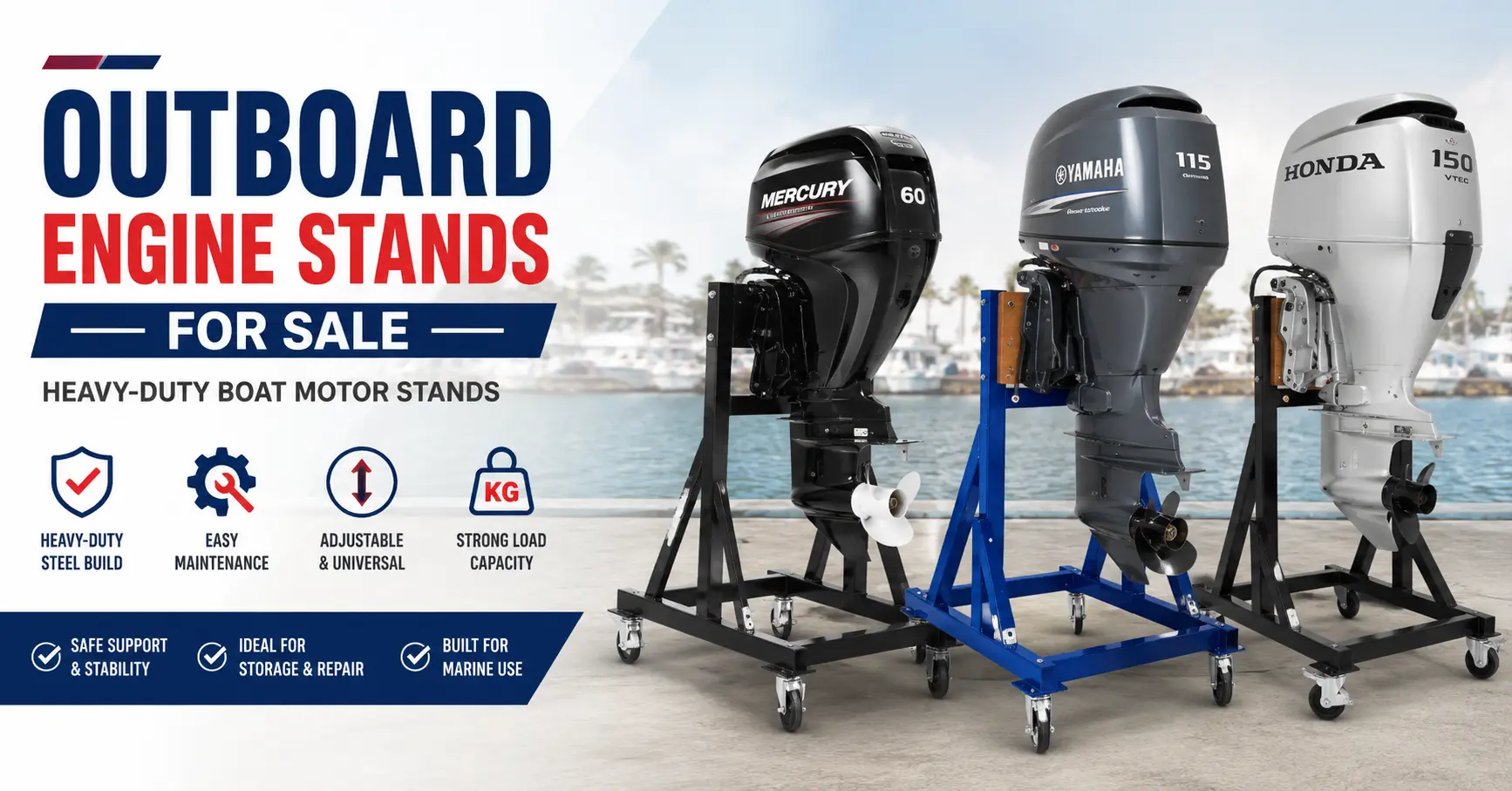
Outboard Engine Stands: The Complete Buying Guide, Types, Uses and Safety
An outboard engine stand is one of the most practical investments any boat owner, marine mechanic or marine workshop can make. Without one, handling a heavy outboard motor during service, off-season storage or transport becomes unnecessarily dangerous and difficult. With the right stand, a 300-pound engine stays secure, accessible and at exactly the right working height every single time.
This guide covers everything you need to know before you buy, from stand types and load ratings to material selection, safety practices and long-term care. Whether you are servicing a small 9.9 HP tiller motor or maintaining a 350 HP V8 offshore powerhouse, there is a stand designed for your exact requirements.
What Is an Outboard Engine Stand
An outboard engine stand is a purpose-built metal fixture that holds an outboard motor in a stable, upright or tilted position independent of a boat transom. The stand clamps or bolts to the engine’s mounting bracket, the same bracket that ordinarily attaches to the transom, so the motor sits exactly as it does on a vessel but entirely freestanding.
Most stands include a main vertical pole or column, a horizontal crossbar that accepts the engine clamp brackets, an adjustable lower support arm or foot to stabilise the lower unit, and a base frame with or without caster wheels. The entire assembly keeps the engine at a comfortable working height, prevents it from tipping, and protects the gear case and propeller from floor contact.
Key distinction: An outboard engine stand is different from a generic engine stand used for automotive motors. Car engine stands bolt to the engine block through threaded bosses. Outboard stands clamp to the transom bracket mount points, which is a marine-specific clamping interface. Always use a stand engineered specifically for outboard motors to avoid clamp slippage or structural failure.
For workshops that also handle heavier lifting tasks, an outboard stand often works alongside dedicated lifting equipment. Our guide on engine lift hydraulics and hoists explains how cherry pickers, engine hoists and hydraulic lifting arms integrate with storage stands to move large outboard motors safely from boat to stand and back again.
Why You Need an Outboard Engine Stand
Many boat owners store their outboard motor by leaning it against a wall, sitting it on the floor, or leaving it bolted to a sawhorse. Each of these methods creates real risk. An unsupported outboard resting on its lower unit can damage the gear case. A motor leaning against a wall can topple without warning. Neither method gives a mechanic safe, comfortable access to all sides of the engine.
- Prevents floor damage to the gear case, anode, skeg and propeller during storage and service
- Provides 360-degree access so mechanics can work on every face of the engine without repositioning
- Stabilises the motor under torque when removing or installing bolts, impellers and lower unit components
- Reduces injury risk by eliminating the need to hold or steady the engine by hand during heavy-torque operations
- Enables safe long-term off-season storage in an upright position that drains water from the cooling passages
- Improves workshop efficiency by keeping motors organised, accessible and ready for fast turnaround
- Supports flush-flushing with a garden hose without needing a separate flushing attachment or a bucket
Professional context: Marine service centres typically allocate one stand per engine bay. High-volume workshops use rolling stands with locking casters so motors can be moved between workstations without additional lifting equipment. This mirrors the workflow logic used in automotive lifts, which you can explore further in our hydraulic car lift guide.
Types of Outboard Engine Stands
The market offers several distinct stand categories, each suited to different use cases. Understanding the differences before purchasing saves time, money and workshop floor space.
Fixed Workshop Stand
A heavy-duty stand designed for permanent placement on a workshop floor. Usually constructed from thick-wall square steel tubing, anchored or weighted, with no caster wheels. Ideal for dedicated marine service bays where engines are serviced in a single location.
Rolling Workshop Stand
Identical in construction to the fixed workshop stand but fitted with four heavy-duty locking caster wheels. Allows the engine to be moved freely around the workshop floor. The most popular choice for busy marine workshops and multi-bay service centres.
Portable Folding Stand
A lightweight stand with folding legs that collapses to a compact flat pack for transport in a van or trailer. Suited to mobile marine mechanics who work at marinas, boatyards and customers’ homes. Generally rated for smaller engines up to around 150 HP.
Storage and Display Stand
Designed primarily for off-season storage rather than active maintenance. Typically has a lower profile, non-adjustable height and no integrated casters. Often sold in sets for high-density storage of multiple motors in a showroom or warehouse environment.
Transport Stand
Built for securing an outboard motor inside a van, trailer or shipping container. Features integrated strapping points, rubber-lined contact surfaces and a low centre of gravity. Not suitable for active workshop use but essential for safe road transport.
Tilt-and-Rotate Stand
A premium stand that allows the engine to be tilted to a horizontal position and rotated 360 degrees around the vertical axis. Gives complete access to every face of the powerhead and lower unit without removing the engine from the stand. Used in high-end service centres.
For workshops managing multiple motors simultaneously alongside other heavy loads, the logistics of stand selection connect directly to broader material handling decisions. Our warehouse layout planning guide covers how to organise floor space efficiently when multiple machines and storage fixtures compete for the same area.
Materials and Build Quality
The material a stand is made from determines its load capacity, corrosion resistance, longevity and weight. Marine environments are exceptionally corrosive. Salt air, bilge residue, fuel and oil all attack bare metal rapidly, which means material selection matters far more for outboard stands than for stands used in dry automotive workshops.
Steel Stands
The majority of outboard engine stands are manufactured from mild steel box section or round tube. Steel stands offer excellent strength-to-cost ratios and are easy to weld, modify and repair. However, uncoated mild steel corrodes aggressively in marine environments. All steel stands intended for marine use must carry one of the following surface treatments:
- Powder coating provides a hard polymer outer layer that resists chips, UV exposure and mild moisture. The most common finish on mid-range marine stands.
- Hot-dip galvanising creates a thick zinc barrier that protects the underlying steel even when scratched. The preferred finish for outdoor storage areas and humid coastal workshops.
- Epoxy paint offers chemical resistance against fuel and oil in addition to moisture protection. Common on high-end professional stands.
- Zinc electroplating provides a thinner, less durable coating than hot-dip galvanising but is adequate for indoor workshop use.
Aluminium Stands
Aluminium stands weigh approximately one-third of equivalent steel stands, which makes them far more practical for portable and transport applications. Aluminium is naturally corrosion-resistant without any surface treatment, making it an excellent choice for outdoor or saltwater-adjacent storage. The trade-off is cost: aluminium stands typically cost 40 to 80 percent more than comparable steel models and have slightly lower weight ratings at a given material cross-section.
Stainless Steel Stands
Stainless steel stands are the premium option for professional marine environments. They combine high strength with outstanding corrosion resistance and an attractive appearance that suits showroom or customer-facing service areas. Stainless stands carry a significant price premium and are typically specified only for commercial marine dealerships and high-throughput professional workshops.
What to avoid: Never use a stand with peeling powder coat, visible bare steel rust or cracked welds at the base or clamp interface. A stand that looks structurally compromised is structurally compromised. Outboard engines are extremely heavy, and a stand failure during maintenance can cause serious injury and engine damage that costs more to repair than a new stand ever would.
Weight Ratings Explained
The weight rating on an outboard engine stand refers to the maximum static load the stand is designed to support. This number must be matched carefully to the actual weight of your outboard motor, and you should always leave meaningful headroom above the engine weight to account for dynamic loads during servicing.
| Engine Class | Typical HP Range | Approximate Weight | Recommended Stand Rating |
|---|---|---|---|
| Small portable | 2.5 to 20 HP | 15 to 55 kg | Minimum 100 kg |
| Mid-range 4-stroke | 25 to 115 HP | 60 to 140 kg | Minimum 200 kg |
| Large 4-stroke | 150 to 250 HP | 150 to 220 kg | Minimum 350 kg |
| V6 offshore | 300 HP | 230 to 280 kg | Minimum 450 kg |
| V8 offshore / commercial | 350 to 600 HP | 300 to 450 kg | Minimum 600 kg |
When selecting a stand for a professional workshop, the recommended practice is to choose the next capacity tier above your heaviest engine. A workshop handling 250 HP engines should use 450 kg rated stands rather than 350 kg stands. This provides a safety factor and future-proofs the investment against larger engines entering the service bay.
The concept of matching rated capacity to actual load applies equally across the broader category of industrial lifting and support equipment. Our scissor lift guide and freight elevator overview both discuss how safety factors are applied in commercial lifting applications, and the same principles translate directly to static engine support equipment.
How to Choose the Right Outboard Engine Stand
Selecting the correct stand comes down to answering five questions honestly about how and where you will use it. Rushing this decision or defaulting to the cheapest available option is a false economy when you are supporting equipment worth tens of thousands of dollars.
- What is the weight of the heaviest engine I will place on this stand? Look up the exact dry weight of your motor in the manufacturer specification sheet. Add 15 percent to account for residual fuel, oil and water weight. Select a stand rated well above this figure.
- Where will the stand be used primarily? Indoor climate-controlled workshop: standard powder coat steel is adequate. Outdoor or coastal storage: hot-dip galvanised steel or aluminium is strongly recommended. Frequent transport: a folding portable stand is required regardless of other factors.
- Do I need the engine to be mobile while on the stand? If the engine will be moved between workstations, a rolling stand with locking casters is essential. If the stand will stay in one location, fixed legs are more stable and less expensive.
- What is the engine’s clamp bracket width and spacing? Outboard mounting brackets vary considerably between manufacturers and models. Verify that the stand’s clamp bar width and bolt spacing is adjustable to accept your engine’s bracket dimensions before purchasing.
- Is the stand certified or rated to a recognised standard? Look for stands manufactured to CE, AS/NZS or ISO structural safety standards. Avoid stands sold with no load rating information, as this typically indicates no formal structural testing has been carried out.
Workshop planning note: If you are equipping a new workshop or expanding an existing marine service centre, the outboard engine stand selection should be part of a broader equipment plan that includes vehicle lifts, material handling equipment and floor layout. Our guide on the best industrial lift and elevator options in the UAE provides context on how marine and industrial workshops source certified heavy-equipment solutions in the region.
Portable vs Fixed: The Core Trade-Off
Portable Stand
- Easy to transport in a van or trailer
- Folds flat for compact storage
- Lower upfront cost
- Versatile for field service work
Portable Stand
- Lower weight ratings
- Less stable under dynamic service loads
- Not suitable for very large V6 or V8 motors
- More wear on joints and folding mechanisms
Fixed Workshop Stand
- High weight capacity
- Maximum stability during service
- Long service life with minimal maintenance
- Can be fitted with casters for mobility
Fixed Workshop Stand
- Not suitable for transport or field use
- Requires dedicated floor space
- Higher upfront investment
- Heavier and more difficult to relocate
Safety Practices for Outboard Engine Stands
An outboard engine stand is a safety device. Like all safety devices, it protects you only when used correctly. The weight of a large modern outboard motor represents a genuine crush hazard, and a stand failure during maintenance can cause severe injury in addition to expensive engine damage.
Before You Mount the Engine
- Inspect all welds, clamp bolts and structural members for cracks, corrosion or deformation before each use
- Verify the stand’s rated load capacity exceeds the engine’s actual weight by a comfortable margin
- Confirm the floor surface is level, clean and free of oil or debris that could cause the stand to slide or tip
- Lock all caster wheels before mounting the engine if the stand is fitted with castors
- Check that all adjustable components are fully tightened and secured before transferring the engine’s weight to the stand
During Maintenance
- Never leave a mounted engine unattended on a stand that is not properly secured
- Apply controlled, gradual force when breaking fasteners. Avoid sudden shock loads that could tip the stand
- Work with an assistant when removing or installing heavy components such as the lower unit
- Never climb on or apply body weight to the stand structure itself
- Keep the work area around the stand clear to allow safe movement and emergency egress
Transferring Engines to and from the Stand
Moving a large outboard motor from a boat transom or a pallet to a stand requires a dedicated lifting device. A cherry picker or engine hoist is the correct tool for this transfer. Attempting to lift a heavy outboard by hand without mechanical assistance puts workshop staff at serious musculoskeletal injury risk and risks dropping the engine on the stand or floor.
Critical safety reminder: Outboard engine stands are designed for static support during storage and maintenance. They are not designed to support an engine that is running under power. Never start an outboard motor while it is mounted on a stand unless the stand is specifically rated and designed for run testing with appropriate water supply and exhaust provisions.
Maintenance and Care of Your Engine Stand
An outboard engine stand is a long-term investment that will outlast many individual motors if maintained properly. A stand that is neglected, corroded or structurally compromised must be retired and replaced immediately rather than continuing to use it.
Routine Inspection Schedule
Inspect the stand before each use for any professional workshop. For personal boat owners who use the stand seasonally, a thorough inspection at the start and end of each season is sufficient. Pay particular attention to the clamp assembly and the weld points at the base frame corners, as these areas carry the highest stress concentration.
Corrosion Prevention
Touch up any chips or scratches in the powder coat finish promptly using compatible spray paint or cold-galvanising compound. Apply a light coat of corrosion-inhibiting oil to exposed metal surfaces at the end of each season. Store the stand indoors or under cover when not in use, even if it is rated for outdoor use.
Caster Wheel Maintenance
Rolling stands with caster wheels require periodic maintenance of the wheel bearings and swivel mechanisms. Clean and re-grease the swivel bearings annually or whenever the castors become stiff or noisy. Replace any castor that has a cracked wheel, seized bearing or damaged locking mechanism immediately.
For workshops that use a range of lifting and support equipment alongside outboard stands, the maintenance principles are consistent across equipment types. Our complete guide to cargo elevator types, costs and safety specifications illustrates how routine inspection and preventive maintenance programmes apply across the full range of commercial lifting equipment.
Comparison: Outboard Engine Stand Types at a Glance
The table below summarises the key characteristics of each stand type to help you identify the best match for your specific situation at a glance.
| Stand Type | Best For | Typical Capacity | Mobility | Price Range |
|---|---|---|---|---|
| Fixed Workshop | Dedicated service bays | Up to 600 kg | None | Mid to High |
| Rolling Workshop | Multi-bay workshops | Up to 600 kg | Full (casters) | Mid to High |
| Portable Folding | Mobile mechanics, field use | Up to 200 kg | Full (transport) | Low to Mid |
| Storage Stand | Off-season storage | Up to 300 kg | Limited | Low |
| Transport Stand | Road and freight transport | Up to 400 kg | By vehicle | Low to Mid |
| Tilt-and-Rotate | Full-service workshops | Up to 500 kg | Optional casters | High |
Frequently Asked Questions
Need Professional Lifting and Support Equipment?
MIE Industry supplies certified engine hoists, workshop stands, hydraulic lifts and industrial material handling equipment across the UAE, Saudi Arabia and the wider Gulf region. Talk to our technical team about your specific requirements.
Get a Free Consultation