
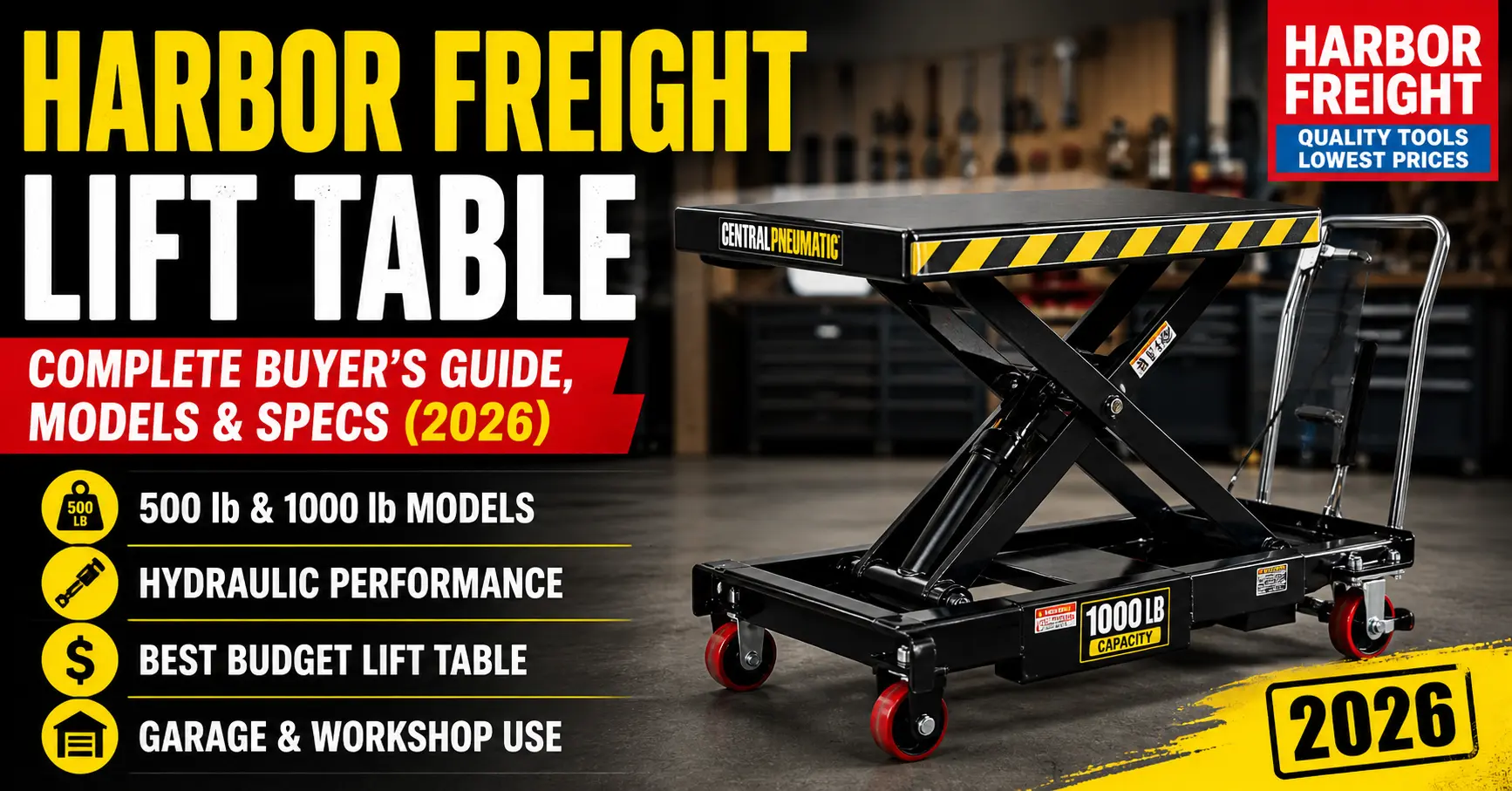
Harbor Freight Lift Table: Models, Specs, Safety & When to Upgrade
If you’ve ever searched for a budget-friendly way to raise heavy loads in a home garage or small workshop, the Harbor Freight lift table almost certainly topped your results. These hydraulic scissor-style carts have become a go-to for DIYers, motorcycle enthusiasts, machinists, and small shop operators across the United States and for good reason: they offer solid functionality at a fraction of the cost of industrial-grade equipment.
But are they right for your application? And when does it make more sense to invest in a purpose-built industrial lift? This complete 2026 guide walks you through every Harbor Freight lift table model, key specifications, real-world performance, safety protocols, maintenance tips, and the exact threshold where you should look beyond Harbor Freight for something more capable.
📋 Table of Contents
- What Is a Harbor Freight Lift Table?
- All Current Models & Specifications (2026)
- How a Hydraulic Lift Table Works
- Top Uses: Workshop, Garage & Beyond
- Pros & Cons: Honest Assessment
- Harbor Freight vs Industrial Alternatives
- Safety Tips & Best Practices
- Maintenance & Hydraulic Oil Guide
- When to Upgrade Beyond Harbor Freight
- FAQ — AI Overview Ready Answers
- Useful Resources
1. What Is a Harbor Freight Lift Table?
A Harbor Freight lift table – often sold under the Pittsburgh Automotive or Franklin brand names – is a portable, hydraulic scissor-lift cart designed to elevate heavy objects from floor level to a comfortable working height. The mechanism uses a foot-operated hydraulic pump to extend a scissor-arm assembly, raising the platform smoothly and incrementally.
Unlike full-size industrial scissor lifts (which can raise personnel or pallet loads to ceiling height), Harbor Freight lift tables are compact, low-profile units intended for shop, garage, and light-commercial use. They sit close to the ground when collapsed – typically 8 to 9 inches – making it easy to slide them under heavy machinery or motorcycle frames.
2. All Current Models & Specifications (2026)
Harbor Freight regularly updates its lift table lineup. Below are the primary models available in 2026, based on the Pittsburgh Automotive and Franklin product families:
| Model / SKU | Capacity | Platform (L × W) | Min Height | Max Height | Weight | Casters |
|---|---|---|---|---|---|---|
| Pittsburgh Automotive 500 lb SKU 61405 | 500 lb (227 kg) | 27¾” × 17¾” | 9¼” | 28½” | ~89 lb | 4″ polyurethane swivel |
| Pittsburgh Automotive 1000 lb SKU 60730 | 1,000 lb (454 kg) | 35″ × 19½” | 9″ | 30″ | ~127 lb | 4″ swivel (2 locking) |
| Franklin 500 lb Hydraulic Table Cart | 500 lb (227 kg) | 28″ × 18″ | 8″ | 30″ | ~85 lb | 4″ swivel (2 locking) |
| Franklin 1000 lb Hydraulic Table Cart | 1,000 lb (454 kg) | 35″ × 19″ | 9″ | 34½” | ~130 lb | 4″ swivel (2 locking) |
| Motorcycle Lift Table (1500 lb) Various SKUs | 1,500 lb (680 kg) | 96″ × 24″ | 8″ | 23″ | ~190 lb | Non-rolling (leg levelers) |
3. How a Hydraulic Lift Table Works
Understanding the mechanics helps you use – and troubleshoot – your lift table more effectively. The hydraulic scissor mechanism is elegantly simple:
Foot Pedal Activates the Pump
Each depression of the foot pedal forces hydraulic fluid from the reservoir into the cylinder. One pump stroke typically raises the platform approximately 1 inch, and it takes roughly 20–25 strokes to reach full height under no load.
Scissor Arms Extend Vertically
The hydraulic ram pushes the scissor-arm linkage outward and upward. The front cross-bar ends are hinged while the rear ends ride on rollers along a fixed track – this geometry converts horizontal force into vertical lift.
Safety Lock Holds the Load
A mechanical safety bar (included with all models) should always be inserted once the desired height is reached. Never rely solely on the hydraulic system to hold a load while working beneath or around it.
Controlled Lowering via Release Valve
The hand lever or release knob gradually opens the return valve, allowing fluid to flow back to the reservoir. This lowers the platform at a controlled rate – never abruptly.
4. Top Uses: Workshop, Garage & Beyond
Motorcycle & Powersports Maintenance
One of the most popular applications for Harbor Freight lift tables is motorcycle service. Users elevate bikes to chest or eye level for oil changes, tire swaps, brake work, and full engine overhauls — dramatically reducing back strain compared to working on the floor. The 1,000 lb model handles most cruisers, baggers, and touring bikes including loaded Goldwings.
Engine & Transmission Work
Paired with an engine hoist (cherry picker), a hydraulic lift table allows mechanics to position heavy powertrains at exactly the right height for installation or removal. This is particularly useful in home garages without overhead hoists.
Heavy Tool & Machinery Positioning
Machinists and woodworkers use lift tables as adjustable-height stands for lathes, mill tables, table saws, drill presses, and belt sanders. With casters locked, the platform becomes a stable, height-adjustable workstation.
Workpiece Transfer & Loading
The low 8–9 inch minimum height lets users slide the table under objects resting on low supports. The load can then be raised and rolled to a workbench, truck bed, or storage shelf at the correct transfer height.
Pinball Machine & Large Electronics Service
A niche but enthusiastic user community employs Harbor Freight lift tables for servicing pinball machines, arcade cabinets, large CNC equipment, and other electronics that require both horizontal support and height adjustability.
Snowblowers, Tillers & Outdoor Equipment
Small-engine repair technicians find these tables invaluable for raising outdoor power equipment to a comfortable working height for carburetor cleaning, blade sharpening, and seasonal maintenance.
5. Pros & Cons: Honest Assessment
✅ Advantages
- Affordable price point – typically $200–$420 retail, less with coupons
- Readily available – 1,400+ Harbor Freight locations nationwide
- Low minimum height – 8–9″ clears most low-profile loads
- Portable – swivel casters allow repositioning anywhere in the shop
- Foot-pedal operation – keeps hands free during lifting
- Surprisingly durable – many users report 10–20+ years of service
- Safety bar included – mechanical safety backup standard on all models
- Wide range of uses – motorcycles, engines, machinery, and more
❌ Limitations
- Limited max height – tops out at 30–34½”, not suitable for full-height access
- Instructions often unclear – hydraulic oil setup especially confusing
- Heavier models are unwieldy – 127–190 lb units are hard to move unassisted
- Not rated for manned use – not a personnel lift; strictly for cargo
- No precision height locking – safety bar has fixed increments only
- Casters can be loud – stock wheels struggle on rough concrete
- Hydraulic seals may weep over time – periodic fluid checks needed
- Not suitable for outdoor or wet environments – surface rust risk
6. Harbor Freight vs Industrial Alternatives
Understanding where Harbor Freight lift tables fit in the broader market helps you make the right investment decision. The table below compares them against professional and industrial alternatives:
| Feature | Harbor Freight Lift Table | Industrial Scissor Lift Table | Hydraulic Freight Elevator | Warehouse Scissor Lift Platform |
|---|---|---|---|---|
| Capacity Range | 500–1,500 lb | 1,000–10,000 lb | 2,000–15,000 lb | 2,000–30,000 lb |
| Max Lift Height | 28–34½” | 36″–96″+ | Floor-to-floor | 24″–120″+ |
| Manned Use | ✗ No | ✓ Some models | ✓ Yes | ✓ Yes |
| Outdoor / Wet Use | ✗ Not recommended | ✓ Stainless options | ✓ Yes | ✓ Yes |
| Certification / Compliance | ✗ Garage/hobbyist | ✓ CE / OSHA compliant | ✓ Full compliance | ✓ Full compliance |
| Commercial / Industrial Use | ✗ Not rated | ✓ Yes | ✓ Yes | ✓ Yes |
| Price Range | $200–$420 | $800–$8,000 | $5,000–$50,000+ | $3,000–$40,000+ |
| Portability | ✓ Excellent | ⚡ Varies | ✗ Fixed install | ✗ Fixed / semi-fixed |
| Warranty & Support | 90 days – 2 years | 1–5 years | Manufacturer warranty | Manufacturer warranty |
7. Safety Tips & Best Practices
Before You Lift
Inspect the lift table before each use. Check that all caster locks engage firmly, verify there are no visible hydraulic leaks around the cylinder or fittings, and ensure the platform surface is clean and free of oil or debris that could cause a load to slide. Never exceed the rated capacity — for the 1,000 lb model, include the weight of everything placed on the platform, not just the primary load.
During the Lift
Keep hands and feet clear of the scissor arm mechanism during operation. If the load feels unstable or the pump requires excessive force, stop immediately and reassess. The effort required to pump increases proportionally with load weight if pumping feels abnormally difficult at a light load, the hydraulic system may need servicing.
Securing the Load
Use ratchet straps or tie-down points whenever the load could shift or topple. For motorcycle use, always secure the front wheel in a proper wheel chock and use tie-downs on both sides before pumping the table to working height. Never assume body weight alone stabilizes a vehicle on the lift.
Lowering Safely
Before lowering, confirm the area below and around the lift is clear of people and objects. Open the release valve gradually a sudden pressure release can cause a rapid drop. Always lower before moving the cart to a new position.
Floor & Surface Conditions
Use lift tables on flat, hard surfaces only. Uneven floors cause rocking that destabilizes loads. If your shop floor has expansion joints or surface irregularities, consider placing the lift on a flat steel plate or plywood panel to provide a level base.
8. Maintenance & Hydraulic Oil Guide
Hydraulic Fluid Type & Level
Harbor Freight lift tables use standard hydraulic jack oil (ISO VG 46 or AW 46 hydraulic fluid). The units do not come pre-filled — you must add fluid before first use. Overfilling is the most common setup mistake; it creates a hydraulic lock that prevents lowering.
Correct fill procedure: Lower the table fully to the collapsed position. Remove the fill plug (typically a small hex screw with a rubber washer on the side of the cylinder). Add fluid slowly until it just reaches the port opening do not overfill. Replace the plug and cycle the table up and down several times to bleed any air from the system.
Regular Inspection Checklist
Perform these checks every 3–6 months under regular use:
- Hydraulic fluid level — low fluid causes short pump strokes and failure to reach full height
- Pivot points and scissor pins — clean, inspect for wear, and lubricate with chassis grease
- Caster condition — check for flat spots, bearing wear, and that locking mechanisms engage positively
- Safety bar and retention clips — ensure bar isn’t bent and clips engage correctly
- Platform surface — remove rust with wire brush, apply rust-inhibiting paint or rubber mat
- Hydraulic seals — any oil weeping around the ram indicates a failing seal; replacement kits are available online
Caster Upgrades
A popular and worthwhile upgrade is replacing the stock 4″ casters with larger polyurethane or rubber wheels. Larger casters roll more smoothly over concrete expansion joints, reduce vibration to delicate loads, and generally make the loaded cart much easier to maneuver.
9. When to Upgrade Beyond Harbor Freight
Harbor Freight lift tables serve millions of users extremely well — but there are clear scenarios where a purpose-built industrial lift is the correct choice:
You Need to Lift More Than 1,500 lb
Harbor Freight’s maximum rated capacity across all consumer models tops out at 1,500 lb. If you’re regularly moving palletized goods, large industrial machinery, or full vehicle drivetrains, you need a lift rated for your actual loads with appropriate safety margins.
You Need to Lift Personnel
No Harbor Freight lift table is rated for manned use. If you need to raise workers to an elevated position for installation, maintenance, or assembly work a certified personnel lift or mezzanine lift system is legally required in commercial and industrial environments.
You Need Height Beyond 34 Inches
Consumer lift tables max out at roughly 34½ inches. Loading dock height is typically 48″, and mezzanine floors may be 8–12 feet up. Applications requiring floor-to-floor goods movement need a freight elevator or fixed platform lift.
Commercial or Industrial Compliance Required
Businesses operating in regulated environments (OSHA-governed facilities, ISO-certified manufacturing, food processing plants, pharmaceutical production) must use certified equipment. Harbor Freight products are not CE marked, OSHA rated, or intended for commercial duty cycles.
You Need Duty Cycle Reliability
A home garage lift table might perform 20–50 cycles per week. Industrial environments may require thousands of cycles per month. Commercial-grade hydraulic lift tables are engineered with hardened seals, larger reservoirs, and structural steel rated for continuous duty.
10. Frequently Asked Questions (FAQ)
Optimized for Google AI Overviews, featured snippets, and voice search.
Need a Heavy-Duty Industrial Lift Solution?
Harbor Freight lift tables are excellent for garages but if your operation demands higher capacity, greater lift height, compliance certifications, or continuous duty performance, MEI Industry engineers the solution. Serving the UAE, Saudi Arabia, and beyond.
🔧 Get a Free Industrial Lift ConsultationUseful Resources
Explore these related guides from MEI Industry to make smarter decisions about lift and elevator systems for any scale of operation:
Written by the MIE Industry Technical Team
MEI Industry is a leading industrial lift and elevator manufacturer serving the UAE, Saudi Arabia, and the broader GCC region. Our engineers specialize in scissor lifts, freight elevators, hydraulic car lifts, and custom cargo handling solutions for commercial and industrial applications. All content is reviewed for technical accuracy and updated annually.