
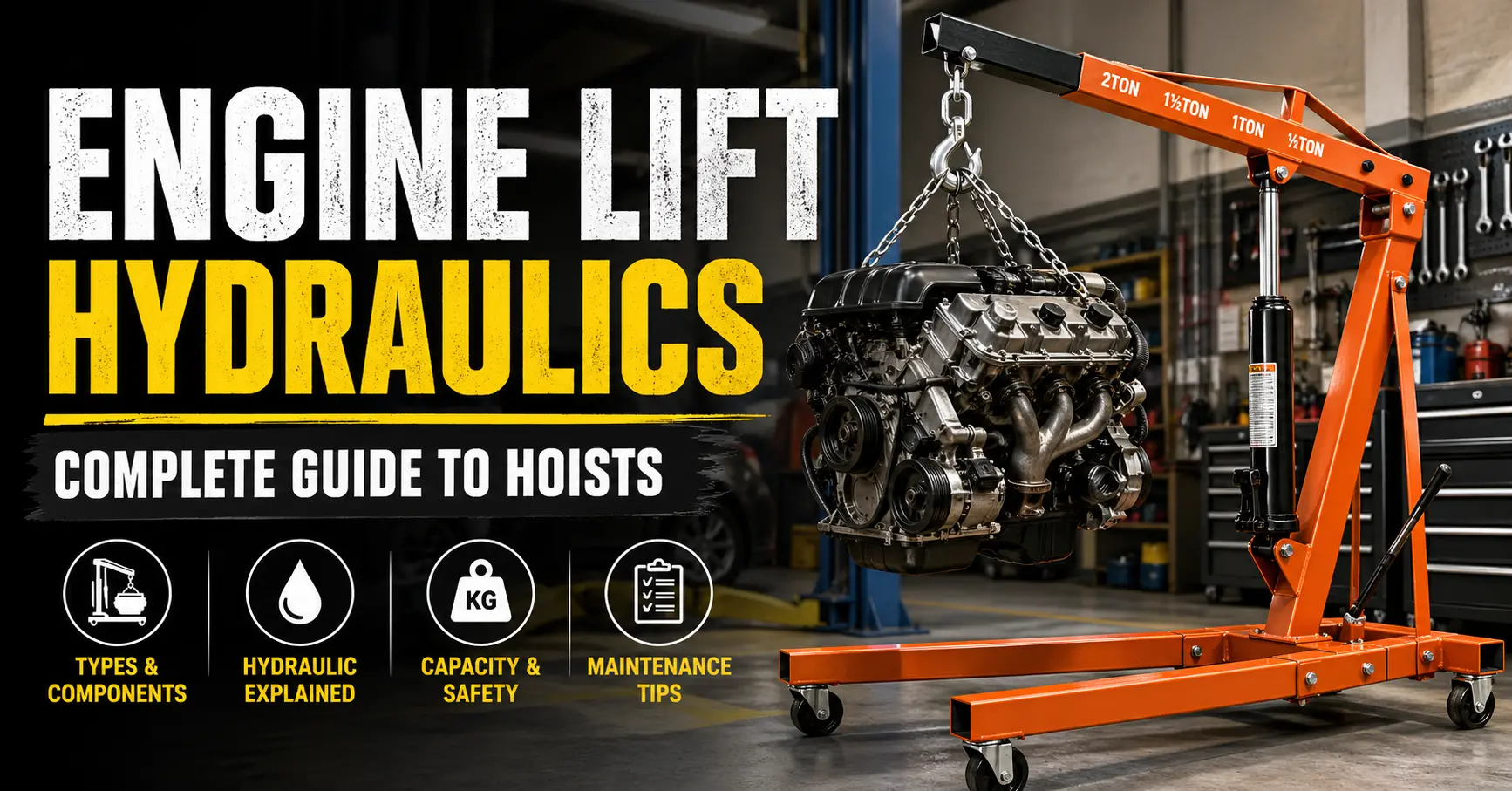
Engine Lift Hydraulics:
The Complete Guide
What Is an Engine Lift Hydraulic System?
A hydraulic engine lift operates on Pascal’s Law: force applied to a sealed, incompressible fluid transmits equally in all directions. When you pump the handle, fluid pressure multiplies inside the cylinder and pushes a piston upward, raising the boom and the engine attached to it.
Key components of every hydraulic engine hoist:
- 🔧Hydraulic cylinder – converts pump pressure into vertical lift force. The heart of the system.
- 📏Extendable boom – adjustable arm positioned directly over the engine with multiple locking positions.
- 🖐Pump handle – the manual lever used to build hydraulic pressure stroke by stroke.
- 🔩Bleed valve – controls descent; open slowly to release pressure and lower the engine.
- ⚙️Caster wheels – allow the fully loaded hoist to roll smoothly across the shop floor.
- 🔗Lifting hook and chains – connect the hoist to the engine’s rated factory lifting points.
How Does a Hydraulic Engine Hoist Work?
Understanding the internal mechanics helps you operate the hoist safely and diagnose problems before they become dangerous.
- Pressure build-up. Pumping the handle draws hydraulic fluid from a reservoir into the cylinder. Each pump stroke increases internal pressure.
- Piston extension. Rising pressure forces a piston rod to extend, pushing the boom upward at its pivot point.
- Load transfer. Chains connected to the hook carry the engine’s weight into the boom and into the hydraulic cylinder.
- Controlled descent. Turning the bleed valve slightly releases fluid back to the reservoir, lowering the engine incrementally.
- Pressure lock. When the bleed valve is closed, trapped fluid holds the boom at a fixed height — as long as internal seals are intact.
Types of Hydraulic Engine Lift Systems
Standard Hoist
Portable, folding frame with manual pump. 1–2 ton capacity. Best for DIY and general auto repair.
Air/Hydraulic
Pneumatic compressor drives the pump. Faster cycle times. Ideal for high-volume commercial shops.
Electric Hydraulic
Motor-driven pump with one-button control. Precise height management. Found in dealerships and fleets.
Overhead Crane
Ceiling or gantry-mounted. 5–20+ ton capacity. Used in industrial and marine engine overhaul.
Engine Hoist Capacity: What Size Do You Need?
Never match the hoist’s rated capacity exactly to your engine weight. Always select a hoist rated above the actual load — this extends equipment service life and provides a critical safety margin. Note that capacity also decreases as the boom is extended.
| Engine Type | Typical Weight | Recommended Capacity |
|---|---|---|
| 4-cylinder (compact) | 200–350 lbs | 1-ton |
| V6 (passenger car) | 350–500 lbs | 1-ton |
| Small block V8 | 500–650 lbs | 1-ton (safe) / 2-ton (preferred) |
| Big block V8 | 650–900 lbs | 2-ton |
| Diesel truck engine | 900–1,800 lbs | 2-ton minimum |
| Heavy equipment / marine | 1,800 lbs+ | 3-ton or overhead |
How to Safely Use a Hydraulic Engine Hoist
Follow every step every time. Skipping any single step is the leading cause of workshop injuries during engine removal.
Before the lift
- Inspect the hoist for leaks, cracked welds, and damaged cylinders before each use.
- Confirm all bolts and nuts are fully tightened — hydraulic hoists ship partially disassembled.
- Clear the workspace of bystanders, tools, and all loose materials.
- Wear close-fitting clothing; avoid loose sleeves or jewelry near hoist components.
- Disconnect all engine accessories: wiring harnesses, coolant lines, fuel lines, exhaust, transmission bolts, and motor mounts.
During the lift
- Position the hoist directly over the engine, centered on the boom hook.
- Attach lifting chains to the engine’s factory-designated lifting points only — these are the only points rated for full engine weight.
- Take up slack slowly and pause when light tension appears — inspect all connection points before continuing.
- Pump the handle smoothly. Never jerk or pump rapidly; sudden pressure spikes cause unexpected movement.
- Raise the engine just enough to clear the engine bay, stop, and recheck stability before moving.
Moving and lowering
- Move the loaded hoist slowly. Never maneuver over uneven flooring with a suspended load.
- Never position yourself under a suspended engine at any time.
- Use the bleed valve to lower the engine in small increments — a quarter-turn at a time.
- Secure the engine to an engine stand before removing chains.
Hydraulic Engine Hoist Maintenance
A quality hydraulic hoist properly maintained will last 10–20 years in a working shop. Most failures are preventable with routine checks.
Hydraulic fluid
Check the fluid level every 6 months. Most hoists use ISO 32 hydraulic oil (also sold as “jack oil”). Low fluid causes slow, jerky, or partial lifts. Overfilling causes seal blowouts.
Cylinder seals
If the hoist drifts downward under a static load, the internal cylinder seals are leaking. Do not use the hoist until seals are replaced.
Bleed valve
A stiff or unresponsive valve usually has debris in the orifice. Flush with hydraulic fluid and clean the valve seat carefully.
Structural inspection
Inspect the boom, frame welds, and legs annually for cracks, corrosion, or deformation. Any cracked weld is grounds for immediate retirement of the equipment.
Casters
Lubricate swivel casters with automotive bearing grease every 6 months. Seized casters make moving a loaded hoist unpredictable and dangerous.
Engine Lift Hydraulics vs. Other Lifting Methods
| Method | Portability | Capacity | Cost | Best For |
|---|---|---|---|---|
| Hydraulic engine hoist | High | 1–3 ton | $150–$600 | DIY & pro garages |
| Air/hydraulic hoist | Medium | 1–3 ton | $400–$1,200 | High-volume shops |
| Electric hoist | Low | 1–5 ton | $500–$3,000 | Dealerships & fleets |
| Overhead gantry crane | None | 5–20 ton | $1,500–$10,000+ | Industrial / marine |
| Engine support bar | High | Up to 1,100 lbs | $80–$200 | Transverse engine work |
Buying Guide: What to Look for in a Hydraulic Engine Hoist
Capacity rating
Buy at least a 2-ton hoist for general automotive work. The extra capacity costs little more but dramatically extends equipment lifespan and your safety margin for heavier engines and boom-extended lifts.
Boom positions
Look for a telescoping boom with at least 4 locking positions. More positions allow flexibility around deep engine bays and help you stay within the hoist’s rated capacity at each extension level.
Frame design
Foldable frames save storage space — confirm the folded footprint fits your shop before buying. Fully welded frames are stronger than bolted assemblies for high-frequency professional use.
Wheel quality
Six wheels (two swivel front, four rear) provide better stability and maneuverability than four-wheel designs. Look for steel casters with a minimum 3-inch diameter and sealed bearings.
Included leveler
An engine leveler lets you tilt the engine during installation to align it with the transmission or mounts. Many quality hoists include one; others sell it separately at $50–$150.
Brand and warranty
Established brands carry 1–2 year warranties. Avoid no-name hoists for anything heavier than a 4-cylinder engine — weld quality and hydraulic cylinder tolerances are where cheap hoists fail first.
Frequently Asked Questions
Abhishek
Certified automotive technician with 15+ years of hands-on experience in engine removal, drivetrain service, and workshop equipment evaluation across independent shops and fleet maintenance facilities. All recommendations reflect real-world professional use.