
Scanner Laser Welding Head
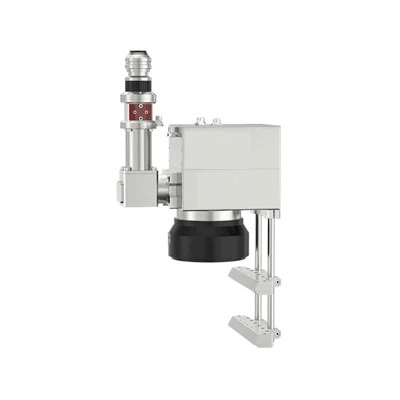
Benefits Of Scanner Laser Welding Head
High precision
Scanner laser welding head can achieve high-precision welding. By controlling the focus position and power of the laser beam, the welding depth and width can be precisely controlled. This is important for some applications that require high-precision welding, such as the production of electronic equipment and micro devices.
Non-contact
Scanner laser welding head is a non-contact welding technology. The laser beam does not need to directly contact the surface of the workpiece to complete the welding process. This means contamination or damage due to contact is avoided and the risk of deformation of the workpiece is reduced.
Welding speed
Scanner laser welding head has fast welding speed. The high energy density of the laser beam can quickly heat and cool the metal material, thus shortening the welding cycle. This is very important for large-scale production and high-efficiency production lines, which can improve production efficiency and reduce costs.
Small heat affected zone
The heat affected zone of scanner laser welding head is smaller than other traditional welding methods. Due to the high energy density of the laser beam and the fast welding speed, laser welding can minimize the spread of heat around the welding area, thereby reducing the size of the heat-affected zone.
The Importance Of Scanner Laser Head In Laser Welding
In laser welding applications, the laser scanner head is responsible for guiding the laser beam along the desired cutting path with high speed and accuracy. By adjusting the focus and positioning of the beam, the scanner head can create intricate designs and shapes on various materials, such as metals, plastics, and composites. Scanner heads are ideal for use in volume manufacturing, where they can shave seconds off cycle times on parts with multiple weld locations by minimizing point-to-point positioning times.
The Role of Scanner Laser Heads in Laser Welding
Laser welding involves using a concentrated beam of light to join two or more materials together. In this process, the scanner laser head is used to precisely control the heat input and penetration depth of the laser beam, ensuring a strong and consistent weld. By adjusting the speed and direction of the beam, the scanner head can produce high-quality welds with minimal distortion and heat-affected zones. This level of control is crucial for industries that demand reliable and durable welds, such as medical device manufacturing, jewelry production, and precision engineering.
What is the Spot Size of Scanner Laser Welding Head?
For a laser with a fixed beam parameter product of 4mm.mrad, the gain in depth of penetration when moving from a spot diameter of 0.4mm to one of 0.14mm, is small for welding speeds less than 7.5m/min, but then increases linearly above this speed. For a given spot diameter of 0.4mm, a laser with a better beam quality generally produces either a faster welding speed for a given depth of penetration, or an increase in depth of penetration for a given welding speed.
Application of Scanner Laser Welding Head
Automobile manufacturing field
In the automobile manufacturing process, scanner laser welding heads can achieve high-precision welding operations, reduce production costs, improve production efficiency, and make the manufacturing process more intelligent.
Electronic manufacturing field
In the field of electronic manufacturing, scanner laser welding heads can weld micro components. They have the advantages of high speed, high precision, and high reliability, and can improve product quality and stability.
Metal manufacturing field
In the field of metal manufacturing, scanner laser welding heads can be used for welding large metal components, which can improve welding strength and connection quality and speed up production.
Aerospace manufacturing
In aerospace manufacturing, scanner laser welding heads are employed for joining critical components such as aircraft fuselages, engine parts, and structural elements. Their ability to produce high-quality welds with minimal heat input makes them suitable for welding thin and heat-sensitive materials used in aircraft construction.
What Metal Materials Can The Scanner Laser Welding Head Cut?
Scanner laser welding heads are suitable for welding various metal materials, including familiar ones like stainless steel, carbon steel, tool steel, galvanized sheet, copper, aluminum, gold, silver, titanium, nickel, tin, chromium, niobium, and alloys. Under certain conditions, laser welding can even join two different metal materials. Common shapes like dots, lines, circles, squares, right angles, and custom shapes can be welded in all directions, achieving spot welding, stack welding, seam welding, butt welding, seal welding, edge welding, and lap welding. The resulting weld points are fine, the seams are robust, and the workpiece deformation is minimal, requiring no grinding or polishing.
Components of Scanner Laser Welding Head
These components typically include focusing optics, a laser source, a scanning system, a control unit, and a cooling system. A scanner head consists of two mirrors, each mounted on very small rotary motors, called galvanometers. These two mirrors and motors are mounted orthogonally to each other such that the rotary motion of the two mirrors translates to linear motion in the X- and Y-axis.
