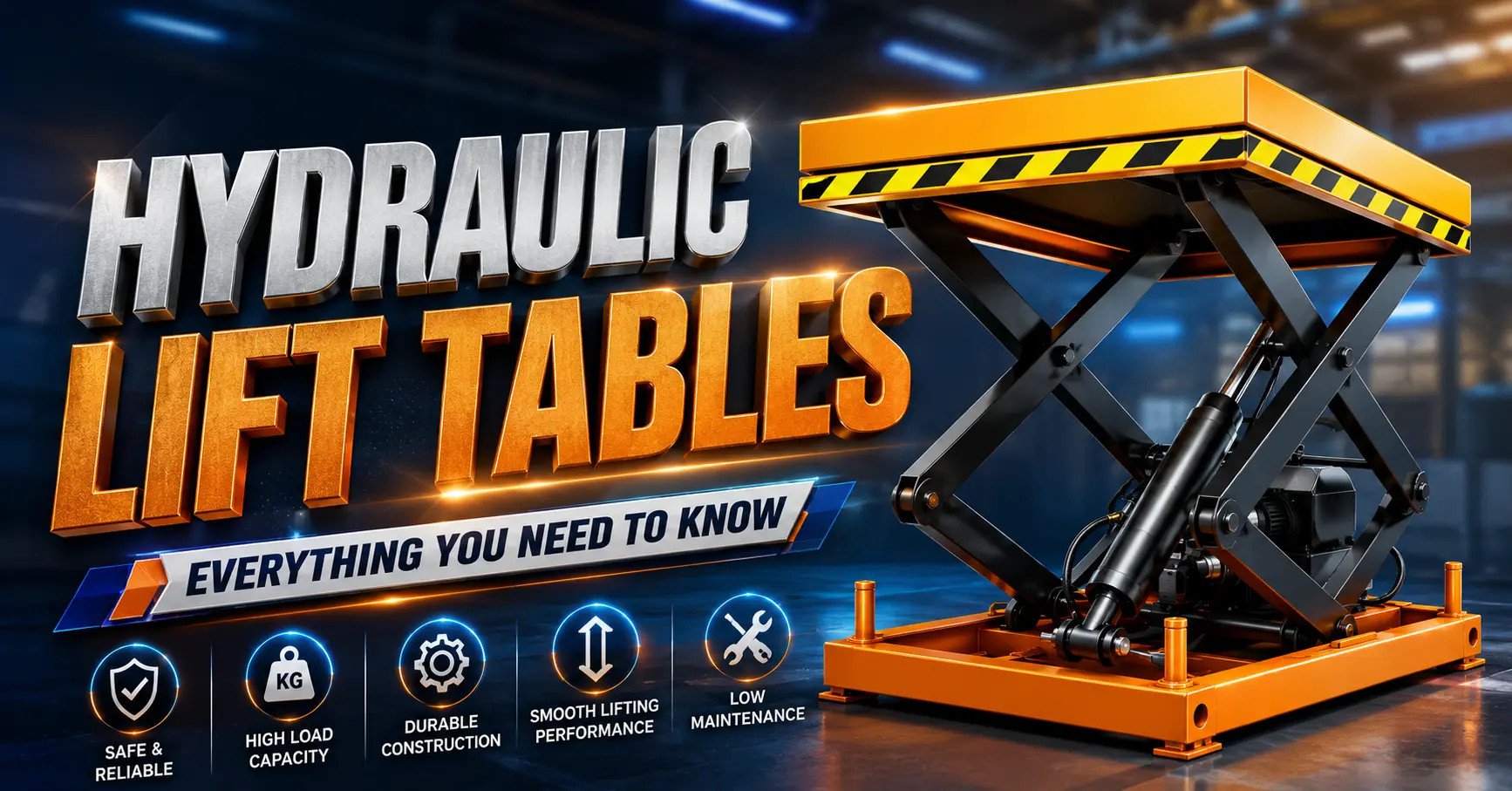
Hydraulic Lift Tables Everything You Need to Know
This guide answers every real question buyers, engineers, and facility managers ask before purchasing a hydraulic lift table.
- Hydraulic lift tables use fluid pressure in a scissor mechanism to raise loads from 200 kg up to 50,000 kg safely
- There are seven distinct types of hydraulic lift tables, each engineered for a specific industrial environment
- Proper sizing requires matching load capacity, platform dimensions, lift height, and duty cycle before purchasing
- ANSI MH29.1, EN 1570-1, and CSA standards govern design and safety across North America and Europe
- Facilities that deploy ergonomic lift tables report up to 35 percent fewer workplace lifting injuries
- MIE Industry manufactures custom hydraulic lift tables with full compliance documentation for global clients
What is a hydraulic lift table and how does it work?
A hydraulic lift table is a motorised work platform that uses pressurised hydraulic fluid to raise, hold, and lower heavy loads with smooth, controlled movement. The operator raises the platform at the push of a button, positions the load at a comfortable working height, and lowers it when finished. The entire process takes seconds and requires no manual effort regardless of the weight involved.
At its core, the mechanism is straightforward. An electric motor drives a hydraulic pump, which pushes fluid into one or more cylinders. As fluid fills the cylinder, it extends and pushes outward on the scissor legs — the crossed steel arms beneath the platform that give the unit its characteristic diamond-like folding motion. When the operator releases pressure, a controlled valve allows fluid to return to the reservoir, and the platform descends at a steady, safe rate.
Core Components of a Hydraulic Lift Table
What are the different types of hydraulic lift tables?
Not all hydraulic lift tables are the same. Manufacturers produce seven distinct configurations, each designed around a specific loading method, space constraint, or industrial use case. Choosing the wrong type is one of the most common and costly procurement mistakes facility managers make.
The Seven Main Types Explained
- Standard Scissor Lift Table- The most widely used type. A single-stage scissor mechanism, platform flush with the floor, loaded by forklift or pallet truck from floor level. Capacity from 500 kg to 5,000 kg. The right choice for most general warehouse and manufacturing applications.
- Low Profile Ground Entry Lift Table - Features a collapsed height as low as 75 mm, allowing a hand pallet truck to roll directly onto the platform without a ramp. Essential when the load arrives at floor level and forklift access is not available.
- Double Scissor Lift Table - Two scissor stages stacked vertically, delivering travel heights of up to 2,400 mm. Suited to applications where the load must rise above conveyor height, machinery, or multi-level assembly lines.
- Pit Mounted Lift Table - Installed flush with the factory floor surface so vehicles or loads can roll directly on without any ramp or approach gradient. Common in automotive production lines and heavy steel processing plants.
- Tilting Lift Table - Adds a hydraulic tilting function to the standard lift, allowing the platform to angle forward by 10 to 45 degrees. Used in dispensing, pouring, and ergonomic parts-presentation applications.
- Mobile Hydraulic Lift Cart - A portable lift table on castors, typically battery or foot-pump powered. Allows operators to move the unit between workstations. Capacity is lower (typically up to 1,000 kg) but flexibility is maximised.
- Tandem and Wide-Span Lift Table - Two lift tables linked hydraulically and operated in synchrony to handle very long or wide loads such as steel sheets, aircraft panels, or timber bundles. Custom engineered for each application.
| Type | Typical Capacity | Max Lift Height | Best Loading Method | Ideal Use Case |
|---|---|---|---|---|
| Standard Scissor | 500 kg to 5,000 kg | 1,200 mm | Forklift | General warehouse and assembly |
| Low Profile Ground Entry | 500 kg to 3,000 kg | 900 mm | Hand pallet truck | Floor-level loading operations |
| Double Scissor | 500 kg to 3,000 kg | 2,400 mm | Forklift or conveyor | Multi-level assembly lines |
| Pit Mounted | 2,000 kg to 50,000 kg | 1,500 mm | Direct roll-on | Automotive and heavy manufacturing |
| Tilting | 500 kg to 2,000 kg | 1,000 mm + tilt | Forklift or manual | Dispensing, ergonomic positioning |
| Mobile Cart | 200 kg to 1,000 kg | 800 mm | Manual placement | Flexible multi-station use |
| Tandem | 5,000 kg to 50,000 kg+ | Custom | Crane or conveyor | Long and wide industrial loads |
MIE Industry Manufactures All Seven Types
MIE Industry engineers and builds every type of hydraulic lift table listed above, including fully custom configurations for pit mounting, tandem synchronised lifts, and explosion-proof control environments. Each unit ships with full compliance documentation.
Request specifications and pricing from MIE IndustryWhat specifications matter most when choosing a hydraulic lift table?
Selecting the wrong specification is the single biggest cause of premature failure, safety incidents, and wasted capital in industrial lift table procurement. The following six parameters must be defined before a valid quote can be produced.
- Load Capacity Always calculate your maximum load weight and add a minimum 50 percent safety margin on top. Industry best practice recommends specifying at 150 percent of your maximum nominal load to account for off-centre placement, dynamic shock loads, and growth in operational requirements. A table rated at 2,000 kg that regularly carries 1,800 kg will wear its cylinder seals and scissor pivots far faster than one rated at 3,000 kg carrying the same load.
- Platform Dimensions The platform must fully support the largest load footprint without overhang. Overhanging loads create eccentric loading forces that multiply stress on the scissor arms and pivot pins, dramatically shortening service life. Standard platforms range from 600 x 900 mm to 2,000 x 3,000 mm, with custom sizes available for special applications.
- Lift Height Range Specify both the minimum collapsed height and the maximum raised height. The collapsed height must be low enough that your loading method can get the load onto the platform. The raised height must bring the load to the exact ergonomic or process height required. For tasks performed standing, the target working height is typically 900 mm to 1,050 mm from the floor.
- Duty Cycle How many lifts per hour does your process require? A table used for 10 cycles per shift operates under fundamentally different thermal and mechanical stress than one cycling 200 times per shift. Hydraulic systems generate heat with each pump actuation, and without adequate reservoir volume and cooling, seal life degrades rapidly in high-cycle applications.
- Power Source Standard units are 230V or 400V three-phase electric. Battery-powered models suit areas without fixed power points or where trailing cables are a safety hazard. Manual foot-pump models are appropriate for very low-frequency lifting only and should not be specified for production environments.
- Environment Outdoor or wash-down environments require stainless steel hydraulic components and sealed electrical enclosures to IP55 or IP65. Food-grade environments require NSF-certified biodegradable hydraulic fluid. Cold store environments (below -10 degrees Celsius) require special low-viscosity hydraulic oils and heated reservoir options to maintain pump performance.
Quick Specification Checklist
- Maximum load weight including pallet, packaging, and heaviest product
- Length and width of the largest load footprint
- Required collapsed (minimum) height
- Required raised (maximum) height
- Number of lift cycles per hour and per shift
- Power supply available at the installation point
- Indoor or outdoor, temperature range, wash-down requirements
- Loading method - forklift, pallet truck, conveyor, or manual
- Floor loading capacity at the installation point
How does a hydraulic lift table compare to pneumatic and electric lift tables?
Buyers frequently ask whether they should choose a hydraulic, pneumatic, or electromechanical lift table. Each technology has genuine strengths, and the right answer depends entirely on your load, environment, and cycle requirements. Here is an honest comparison:
| Factor | Hydraulic Best for Heavy Loads | Pneumatic (Air Bag) | Electromechanical |
|---|---|---|---|
| Maximum Load Capacity | Up to 50,000 kg | Up to 3,000 kg | Up to 5,000 kg |
| Positioning Accuracy | Good (±5 mm) | Variable with load weight | Excellent (±0.5 mm) |
| Contamination Risk | Hydraulic oil (manageable) | None — fluid free | None |
| High Cycle Performance | Good (with adequate reservoir) | Excellent | Good (heat management required) |
| Cold Environment Performance | Requires special fluid | Excellent | Good |
| Food and Pharma Suitability | Possible with NSF fluid | Preferred option | Good |
| Capital Cost | Lowest for heavy duty | Medium | Highest |
| Maintenance Complexity | Moderate (fluid, seals) | Low | Moderate (motor, drive) |
| Outdoor Suitability | Excellent with sealing | Limited | Good with enclosure |
Which industries use hydraulic lift tables and for what applications?
Hydraulic lift tables are not limited to warehousing. Their combination of raw lifting power, compact footprint, and long service life makes them indispensable across a wide range of industries. Below are the most common sectors and the specific tasks each relies on these machines to perform.
| Industry | Primary Application | Key Requirement |
|---|---|---|
| Warehousing and Logistics | Dock levelling, pallet positioning, conveyor height matching | High cycle duty, forklift compatibility |
| Automotive Manufacturing | Engine assembly positioning, underbody access, vehicle rotation | Pit mount, heavy capacity, repeatability |
| Food and Beverage | Drum tipping, ingredient dispensing, line feeding | NSF fluid, stainless surfaces, wash-down rating |
| Steel and Metal Processing | Sheet feeding, coil handling, press tending | Very high capacity, tandem synchronisation |
| Printing and Packaging | Roll and reel handling, pallet build-up stations | Precise height control, low collapsed height |
| Pharmaceuticals | Reactor vessel positioning, clean room material transfer | Contamination free, stainless, GMP documentation |
| Construction and Utilities | Equipment positioning, pipe and duct installation | Outdoor rating, battery power, rough terrain base |
| Aviation and Aerospace | Component assembly, fuselage access, landing gear work | Ultra-high capacity, custom platform, safety fusing |
What safety standards must a hydraulic lift table meet?
This is one of the most important questions buyers fail to ask, and one of the most common ways they expose their facility to liability, failed inspections, and genuine injury risk. Hydraulic lift tables are classified as machinery and must comply with specific standards depending on where they are used and what they are used for.
Key Standards by Region
- ANSI MH29.1 (North America) - The primary US and Canadian standard governing the design, manufacture, and safe use of industrial scissors lift tables. Covers stability, platform guarding, control systems, and operator training requirements. Any lift table purchased for industrial use in North America should carry ANSI MH29.1 compliance documentation.
- UL 508A (North America) - Certifies the industrial control panels built into the lift table's electrical system. A UL Listed controller means the electrical components have been independently tested against rigorous safety benchmarks.
- EN 1570-1 (Europe) - The harmonised European standard for lift tables. Specifies requirements including minimum burst pressure of hydraulic hoses, guarding of scissor mechanism pinch points, and mandatory safety valves.
- ISO 4413 - International standard governing general safety requirements for hydraulic systems and components, including hose ratings, pressure relief valve sizing, and fluid contamination limits.
- ISO 13857 - Defines safety distances to prevent access to hazardous areas, including the gap between a descending scissor lift platform and the floor.
- CSA B44 (Canada) — Applies specifically to lifting equipment used in Canadian facilities. Required for TSSA compliance sign-off in Ontario and equivalent provincial authority approvals.
Mandatory Safety Features on Every Compliant Unit
- Velocity fuse or safety check valve to prevent uncontrolled descent if a hose fails
- Overload protection shutting down the pump before structural limits are exceeded
- Mechanical safety props or locking legs for maintenance access under raised platform
- Scissor mechanism toe guards to prevent foot crush injuries during descent
- Emergency stop button accessible from the operator position
- Non-slip platform surface with rated load capacity label permanently attached
- Platform edge guarding or interlocked perimeter gates for personnel access applications
MIE Industry Supplies Full Compliance Documentation
Every hydraulic lift table manufactured by MIE Industry ships with a complete compliance package including design calculations, material certificates, hydraulic test records, and applicable standard declarations. Our engineering team can prepare region-specific documentation for North American, European, Middle Eastern, and Asian regulatory frameworks.
Ask MIE Industry for a compliance documentation sampleHow do you maintain a hydraulic lift table to extend its service life?
A well-maintained hydraulic lift table should deliver a million or more lift cycles before requiring major overhaul. The machines that fail prematurely almost always do so because of three neglected maintenance tasks - hydraulic fluid condition, pivot pin lubrication, and seal inspection. Here is the complete maintenance framework broken down by frequency.
Daily Checks (Before First Use)
- Inspect the platform surface and side guarding for visible damage or deformation
- Check that the emergency stop button is accessible and functioning
- Listen for abnormal noise during the first test lift - grinding or chattering indicates a dry pivot pin
- Inspect hydraulic hoses visually for abrasion, kinking, or seepage at fittings
- Confirm the load capacity label is legible and the rated weight has not been exceeded overnight
Monthly Maintenance Tasks
- Check hydraulic fluid level in the reservoir and top up with the manufacturer-specified grade only
- Lubricate all scissor arm pivot pins with the specified grease - this single task has the greatest impact on service life
- Inspect cylinder rod surface for scoring, pitting, or corrosion that would accelerate seal wear
- Test the overload protection by applying a known excess load and confirming the pump shuts down correctly
- Inspect all electrical connections at the control panel and motor for corrosion or loose terminals
Annual Maintenance Tasks
- Full hydraulic fluid change — contaminated fluid carries abrasive particles that destroy pump internals and cylinder walls
- Replace all hydraulic hoses regardless of visual condition if more than five years old — internal degradation is invisible
- Load test to rated capacity with calibrated weights, documented by a qualified engineer
- Inspect all structural welds on scissor arms and platform frame using dye penetrant or magnetic particle testing in high-cycle applications
- Calibrate and test all safety devices including velocity fuse, overload cutout, and mechanical safety props
What does a hydraulic lift table cost and what affects the price?
Hydraulic lift table pricing spans an enormous range because the variables that drive cost - capacity, travel height, platform size, duty cycle, and custom features - compound rapidly. Understanding the cost drivers helps you build an accurate budget and avoid the common mistake of specifying on price alone.
| Configuration | Typical Capacity | Indicative Price Range (USD) | Main Cost Driver |
|---|---|---|---|
| Standard light duty | 500 to 1,000 kg | $800 to $2,500 | Commodity scissor and cylinder |
| Standard medium duty | 1,000 to 3,000 kg | $2,500 to $6,000 | Reinforced scissor, larger cylinder |
| Heavy duty industrial | 3,000 to 10,000 kg | $6,000 to $18,000 | Heavy steel frame, dual cylinder |
| Double scissor (high rise) | 1,000 to 3,000 kg | $5,000 to $14,000 | Second scissor stage, taller frame |
| Pit mounted | 5,000 to 50,000 kg | $12,000 to $80,000+ | Structural capacity, pit integration |
| Stainless food grade | 500 to 2,000 kg | $4,000 to $12,000 | Material grade, NSF certification |
| Custom tandem | 10,000 to 50,000 kg+ | $30,000 to $200,000+ | Custom engineering, synchronisation |
The Five Biggest Cost Factors
- Load Capacity - Every doubling of load capacity roughly doubles the structural steel requirement and requires a larger cylinder, pump, and motor. This is the single largest price driver.
- Lift Height - Taller travel height requires longer scissor arms, a greater cylinder stroke, and more complex stability engineering. Double scissor units can cost 60 to 80 percent more than equivalent single-stage units.
- Surface Finish and Material - Standard mild steel with powder coat is the base price. Hot-dip galvanised adds 15 to 25 percent. Stainless steel construction for food and pharma environments adds 40 to 80 percent.
- Control System Complexity - A basic push-button controller is inexpensive. Adding variable speed control, PLC integration, remote operation, SCADA connectivity, or explosion-proof enclosures each adds cost incrementally.
- Customisation - Custom platform sizes, conveyor tops, ball transfer decks, turntable tops, tilting functions, and non-standard collapsed heights all involve additional engineering time and fabrication cost.
How do you choose the right hydraulic lift table for your facility?
Choosing the correct hydraulic lift table is a structured engineering decision, not a catalogue selection. The following step-by-step process is used by industrial engineers and procurement managers at leading facilities worldwide.
- Define the load Weigh your heaviest load configuration including pallet, packaging, and any tooling. Measure its footprint. Note whether the weight is evenly distributed or concentrated at one point. Document this as your load specification.
- Define the height range Measure the height of your loading source (floor, conveyor, truck bed, or machine feed point). Measure the required working height. The difference gives you the required lift travel. Add 50 mm above and below for operational margin.
- Define the loading method If a forklift loads the table, a standard unit works. If a hand pallet truck must roll directly onto the platform, you need a ground entry model with a collapsed height under 90 mm. If loads arrive on a conveyor, specify a powered roller top deck.
- Calculate your duty cycle Count the number of complete lift-and-lower cycles per hour in your most demanding shift. Communicate this number directly to your supplier. This determines cylinder sizing, reservoir volume, and motor duty rating.
- Define the environment Document temperature range, humidity, exposure to water or chemicals, and whether the unit will be indoors or outdoors. This determines surface treatment, seal type, fluid specification, and electrical enclosure rating.
- Request written compliance documentation Before placing any order, request written confirmation of which safety standard the unit complies with, a copy of the load test certificate, and the hydraulic calculation package. A legitimate manufacturer provides this without hesitation.
- Confirm parts and service availability Ask the supplier where seal kits, cylinder replacement parts, and pump units are stocked, and what the typical lead time for spare parts is. For a machine expected to run for 20 years, parts availability is not an afterthought.
MIE Industry Provides Free Application Engineering
Send MIE Industry your load specification, required height range, loading method, and environment details and their engineering team will return a recommended specification, drawing, and price within 48 hours. No commitment required for the initial consultation.
Submit your application requirements to MIE IndustryFrequently asked questions about hydraulic lift tables
These are the questions buyers, safety managers, and maintenance engineers ask most often. Each answer is written to be definitive and actionable.
- Always specify at 150 percent of your maximum load — never at your maximum operating load directly
- Ground entry models are required when hand pallet trucks must load the platform from floor level
- ANSI MH29.1 in North America and EN 1570-1 in Europe are the minimum compliance requirements — demand written documentation
- Annual hydraulic fluid changes and monthly pivot pin lubrication are the two maintenance tasks with the greatest impact on service life
- A velocity fuse is not optional — it is the primary safety device that prevents catastrophic platform collapse
- Contact MIE Industry for application engineering, custom configurations, and certified hydraulic lift tables for any industry
Hydraulic Lift Tables Are a Long Term Investment, Not a Commodity Purchase
The difference between a hydraulic lift table that serves your facility reliably for 20 years and one that fails, causes an injury, or fails a compliance inspection within three years almost never comes down to price. It comes down to specification accuracy, manufacturer integrity, and maintenance discipline.
A correctly specified hydraulic lift table eliminates ergonomic injury risk, integrates seamlessly into your material flow, and pays back its capital cost in reduced labour and injury costs within the first two to three years. One that is under-specified or uncertified does the opposite — it creates ongoing liability and operational disruption.
MIE Industry manufactures hydraulic lift tables to order for facilities across North America, the Middle East, and Asia. Every unit is engineered to the client's exact specification, tested under full load before shipment, and delivered with complete compliance documentation. Their engineering team provides free application consultations for projects of any scale.
Need a Hydraulic Lift Table Built to Your Specification?
Share your load, height, environment, and application details with the MIE Industry engineering team and receive a recommended specification, drawing, and quote within 48 hours.
Contact MIE Industry - Free Consultation